
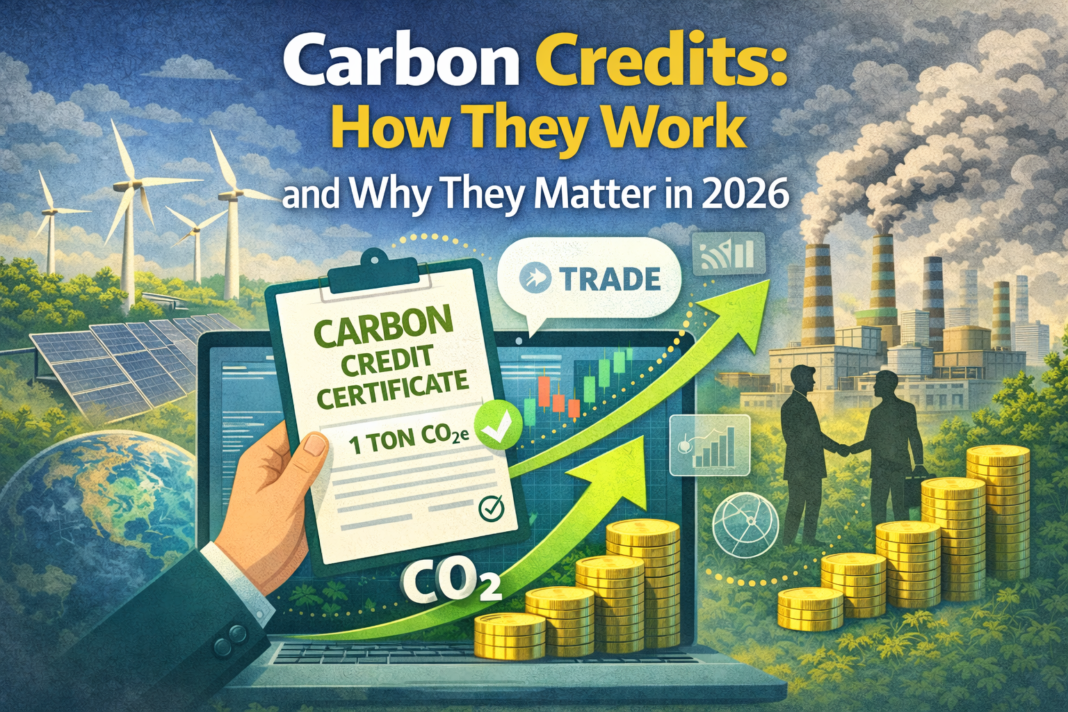
The system is built on the “cap-and-trade” principle or voluntary offsetting:
Creation: A project (like a wind farm, a reforestation effort, or a farmer changing soil practices) proves that it has prevented 1 ton of CO2 from entering the air.
Verification: Independent auditors check the math and the project’s impact.
Issuance: Once verified, a digital “Carbon Credit” is issued to the project owner.
Trading: The project owner sells this credit to someone else—usually a company that cannot easily reduce its own emissions.
The “Balance Sheet” Analogy
• Carbon Debt: A factory emits 1,000 tons of CO2
• Carbon Credit: A forest absorbs 1,000 tons of CO2
• The Trade: The factory buys the forest’s credits. On paper, the factory’s net impact on the planet becomes zero.
Why Do People Trade Them?
There are two main reasons why someone would buy a carbon credit:
• Compliance (The Law): Governments set a limit (a “cap”) on how much pollution a company can produce. If the company goes over the limit, they must buy credits to cover the excess or face heavy fines.
• Voluntary (The Reputation): Companies like Google, Microsoft, or Tata Power buy credits voluntarily to meet “Net Zero” goals and show customers they are environmentally responsible.
Key Terms to Know
• CO2e: This stands for “Carbon Dioxide Equivalent.” It includes other gases like Methane (CH4), which are often more harmful than but are converted into a value for trading.
• Sequestration: The process of capturing and storing carbon (e.g., trees “sequester” carbon).
• Additionality: A rule stating that a project only gets credits if it wouldn’t have happened without the money from the carbon credits. (For example, you can’t claim credits for a forest that was already protected by law).
The Pros and Cons of Carbon Credit Trading
While carbon credits are a vital tool for reaching global “Net Zero” targets, they are often a subject of intense debate. Here is a breakdown of why they are celebrated and why they are sometimes criticized.
The Benefits (The “Pros”)
• Economic Incentive for Clean Energy: It turns “being green” into a source of revenue. For a renewable energy developer or a sustainable farmer, carbon credits provide the extra cash flow needed to make their projects profitable.
• Funds Global South Projects: Carbon markets often channel money from wealthy corporations in developed nations to impactful projects in developing countries like India, supporting local jobs and biodiversity.
• Accelerates Innovation: By putting a price on carbon, companies are incentivized to invest in new technologies (like Green Hydrogen or Carbon Capture) to avoid the high cost of buying credits.
• Quantifiable Results: Unlike general “green initiatives,” carbon credits are measurable. One credit equals exactly one ton of CO2e, allowing for standardized tracking of climate progress.
The Challenges (The “Cons”)
• The “License to Pollute” Risk: Critics argue that wealthy companies might simply buy credits to keep their “business as usual” operations running instead of doing the hard work of actually reducing their own factory emissions.
• Greenwashing Concerns: Not all credits are created equal. In the past, some “junk” credits were issued for projects that didn’t actually reduce emissions, leading to claims of greenwashing. (Note: 2026 regulations like the CCTS aim to fix this).
• Additionality Issues: A major challenge is proving “additionality”—the idea that the carbon reduction would not have happened without the credit money. If a forest was never in danger of being cut down, selling credits for it doesn’t actually help the atmosphere.
• Market Volatility: Like any commodity, the price of carbon credits can fluctuate wildly. This price uncertainty can make it difficult for project developers to plan long-term investments.