
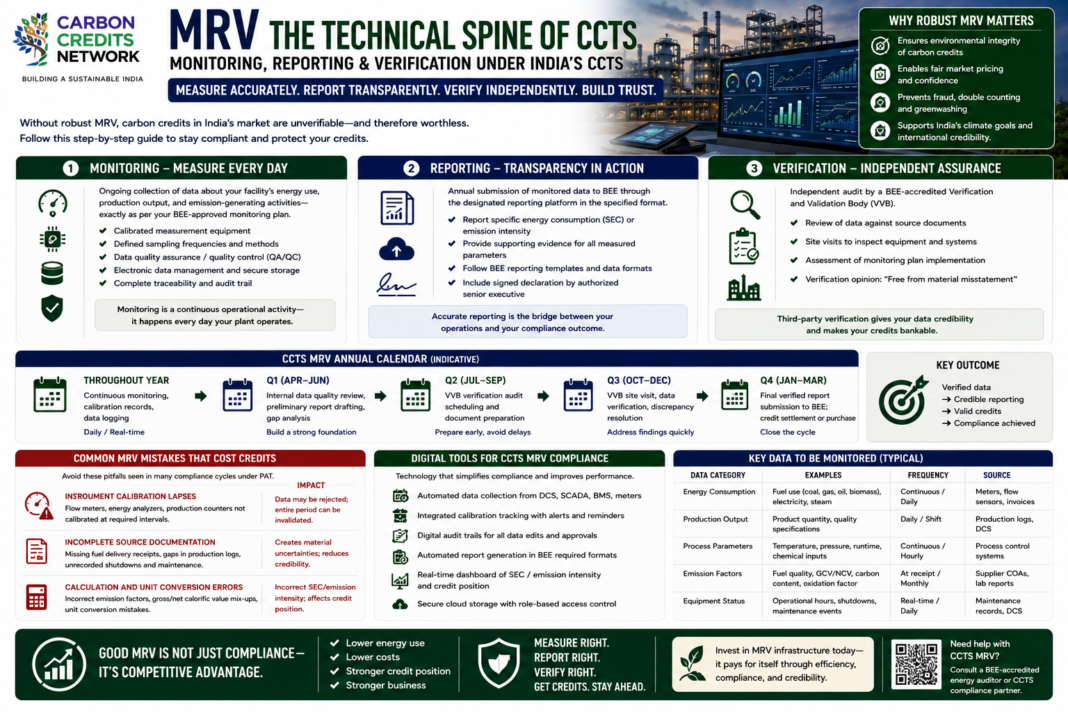
Monitoring, Reporting, and Verification (MRV) is the technical spine of India’s Carbon Credit Trading Scheme. Without robust MRV, the carbon credits that flow through India’s market would be unverifiable — and therefore worthless. This step-by-step guide covers everything obligated entities need to know.
The Three Components of CCTS MRV
Monitoring is the ongoing collection of data about your facility’s energy consumption, production output, and emission-generating activities, following the exact protocols specified in your BEE-assigned monitoring plan. This includes calibrated measurement equipment, defined sampling frequencies, data quality assurance procedures, and electronic data management systems. Monitoring is a continuous operational activity — it happens every day the facility operates, not just at year-end reporting time.
Reporting is the annual submission of your monitored data to BEE through the designated reporting platform, structured in the format specified by BEE’s reporting templates. Reports must include your specific energy consumption (SEC) or emission intensity, supporting evidence for all measured parameters, and a signed declaration by an authorized senior executive.
Verification is an independent audit of your monitoring and reporting by a BEE-accredited Verification and Validation Body (VVB). The VVB reviews your data against source documents, conducts site visits to inspect measurement equipment, and issues a verification opinion that your reported data is “free from material misstatement.”
📅 CCTS MRV Annual Calendar (Indicative)
Throughout Year: Continuous monitoring, calibration records, data logging
Q1 (Apr–Jun): Internal data quality review, preliminary report drafting
Q2 (Jul–Sep): VVB verification audit scheduling and document preparation
Q3 (Oct–Dec): VVB site visit, data verification, discrepancy resolution
Q4 (Jan–Mar): Final verified report submission to BEE; credit settlement or purchase
Common MRV Mistakes That Cost Credits
After analyzing dozens of compliance cycles across PAT (the predecessor scheme), the most common MRV failures cluster around three issues. Instrument calibration lapses are the most frequent: flow meters, energy analyzers, and production counters not calibrated at required intervals produce data that verifiers cannot accept, potentially invalidating entire monitoring periods. Incomplete source documentation — missing fuel delivery records, gaps in production logs, or unrecorded plant shutdowns — creates gaps the verifier flags as material uncertainties. Calculation errors in applying emission factors or unit conversions can significantly affect the reported emission intensity figure and therefore the credit position.
Digital Tools for CCTS MRV Compliance
Several software platforms are emerging to support CCTS MRV compliance, offering automated data collection from building management systems, integrated calibration tracking and alert systems, digital audit trails for all data modifications, automated report generation in BEE’s required format, and dashboard-level visibility of real-time credit position based on monitored performance.
The most successful obligated entities treat MRV not as a regulatory burden but as an operational intelligence system. When you know your real-time energy intensity across every production unit, you can identify efficiency opportunities that reduce both costs and emissions — improving your credit position as a direct result of better operations. MRV infrastructure, properly implemented, pays for itself many times over.