
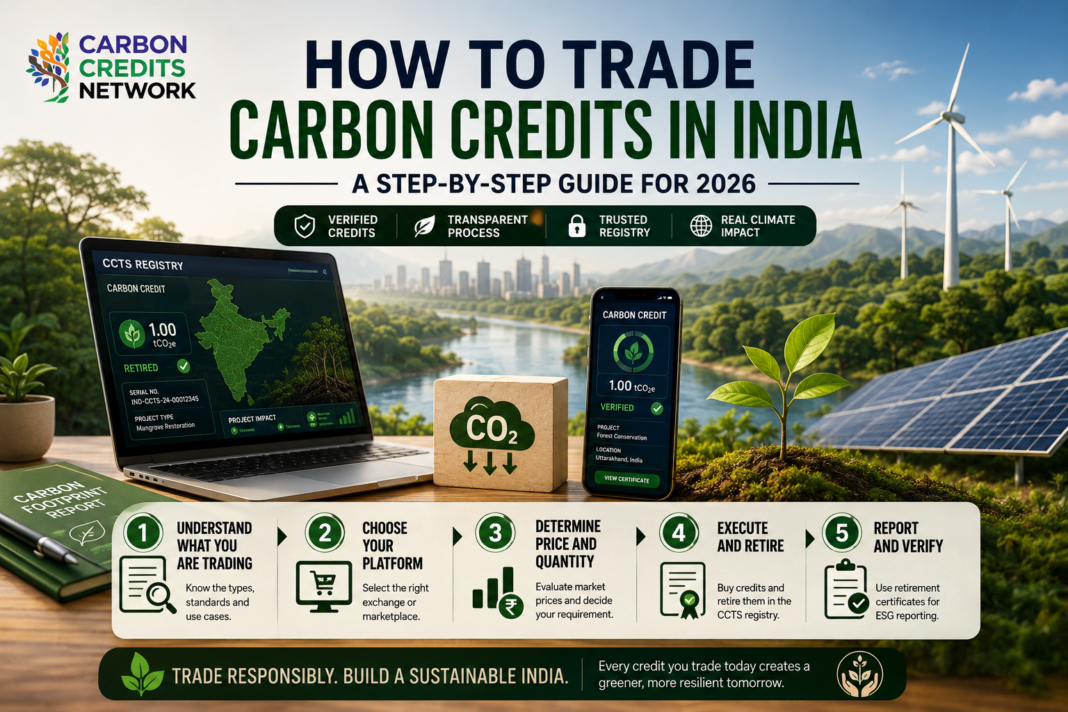
With the CCTS framework operational and the national carbon registry onboarding participants, the question businesses, investors, and project developers are asking most urgently is no longer whether to trade carbon credits in India — it’s how. This guide walks you through the process step by step.
Step 1 — Understand What You Are Trading
There are two distinct types of carbon credits in India’s market. Indian Carbon Credits (ICCs) are issued under the CCTS framework by BEE, specifically for Indian compliance and voluntary buyers. Internationally recognized credits from Verra (VCS) or the Gold Standard are issued by projects verified under globally accepted methodologies and can be used for international corporate net zero commitments. For domestic compliance, ICCs are what you need. For international ESG reporting, internationally recognized credits carry more universal acceptance.
Step 2 — Choose Your Platform
India’s carbon credits currently trade through two channels. The Indian Energy Exchange (IEX) and the Power Exchange India Limited (PXIL) are the primary regulated exchanges where CCTS-compliant credits will trade under BEE oversight — appropriate for larger institutional transactions. For voluntary credits and smaller transactions, broker platforms and emerging fintech marketplaces connect buyers and sellers, though buyers should exercise caution about verification standards.
🔄 Carbon Trade Checklist Before You Buy
✅ Confirm the credit’s verification standard (CCTS, Verra VCS, Gold Standard)
✅ Check the vintage year — is it within your acceptable range?
✅ Verify the project type matches your ESG or compliance needs
✅ Confirm the credit has not already been retired (check registry)
✅ Get the unique serial number for your records
✅ Obtain a retirement certificate for reporting purposes
Step 3 — Determine Your Price and Quantity
Carbon credits are priced per tonne of CO₂e. In India’s current market, prices range from ₹250 to ₹1,000+ depending on quality and type. Before trading, determine: how many tonnes you need to offset (based on your carbon footprint assessment), what quality tier meets your reporting requirements, and your price tolerance — market price or limit order?
Step 4 — Execute and Retire
Once purchased, carbon credits must be formally “retired” in the registry to count as an offset for reporting purposes. Retirement is the permanent cancellation of the credit — ensuring it cannot be sold to another buyer. On India’s CCTS registry, retirement generates a timestamped certificate. This certificate is the document you include in your sustainability report, BRSR filing, or ESG disclosure to substantiate your offset claim.
Step 5 — Report and Verify
Under SEBI’s mandatory BRSR framework, companies in India’s top 1,000 listed firms must disclose Scope 1, 2, and 3 emissions and any offsets purchased. Your retirement certificates from the CCTS registry serve as the primary evidence for these disclosures. Third-party assurance of your BRSR sustainability data — increasingly required by institutional investors — means your carbon offset documentation must be watertight.
India’s carbon market is young but growing fast. Start with small transactions to understand the process, work with accredited brokers on your first few trades, and always verify the credit’s registry status independently before completing payment. The carbon market rewards informed participants — and penalises those who assume any “green” certificate is the same as a verified carbon credit.