
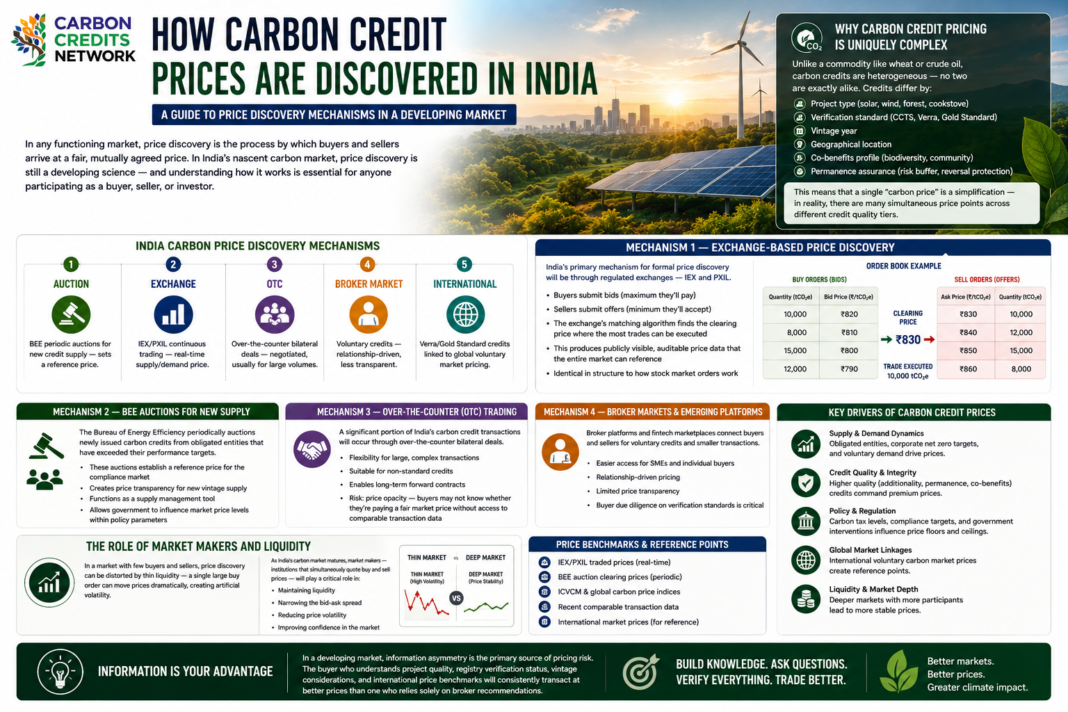
In any functioning market, price discovery is the process by which buyers and sellers arrive at a fair, mutually agreed price. In India’s nascent carbon market, price discovery is still a developing science — and understanding how it works is essential for anyone participating as a buyer, seller, or investor.
Why Carbon Credit Pricing Is Uniquely Complex
Unlike a commodity like wheat or crude oil, carbon credits are heterogeneous — no two are exactly alike. Credits differ by project type, verification standard, vintage year, geographical location, co-benefits profile, and permanence assurance. This means that a single “carbon price” is a simplification — in reality, there are many simultaneous price points across different credit quality tiers.
Mechanism 1 — Exchange-Based Price Discovery
India’s primary mechanism for formal price discovery will be through regulated exchanges — IEX and PXIL. On these platforms, buyers submit bids (maximum they’ll pay) and sellers submit offers (minimum they’ll accept), and the exchange’s matching algorithm finds the clearing price where the most trades can be executed. This produces publicly visible, auditable price data that the entire market can reference — identical in structure to how stock market orders work.
📊 India Carbon Price Discovery Mechanisms
Auction: BEE periodic auctions for new credit supply — sets a reference price
Exchange: IEX/PXIL continuous trading — real-time supply/demand price
OTC: Over-the-counter bilateral deals — negotiated, usually for large volumes
Broker Market: Voluntary credits — relationship-driven, less transparent
International: Verra/Gold Standard credits linked to global voluntary market pricing
Mechanism 2 — BEE Auctions for New Supply
The Bureau of Energy Efficiency periodically auctions newly issued carbon credits from obligated entities that have exceeded their performance targets. These auctions establish a reference price for the compliance market and function as a supply management tool, allowing the government to influence market price levels within policy parameters.
Mechanism 3 — Over-the-Counter (OTC) Trading
A significant portion of India’s carbon credit transactions will occur through over-the-counter bilateral deals. OTC markets offer flexibility for large, complex transactions involving non-standard credit types or long-term forward contracts. The risk in OTC markets is price opacity: buyers may not know whether they’re paying a fair market price without access to comparable transaction data.
The Role of Market Makers and Liquidity
In a market with few buyers and sellers, price discovery can be distorted by thin liquidity — a single large buy order can move prices dramatically, creating artificial volatility. As India’s carbon market matures, market makers — institutions that simultaneously quote buy and sell prices — will play a critical role in maintaining liquidity and narrowing the bid-ask spread.
In a developing market, information asymmetry is the primary source of pricing risk. The buyer who understands project quality, registry verification status, vintage considerations, and international price benchmarks will consistently transact at better prices than one who relies solely on broker recommendations. Building carbon market literacy directly improves the economics of every transaction you make.