
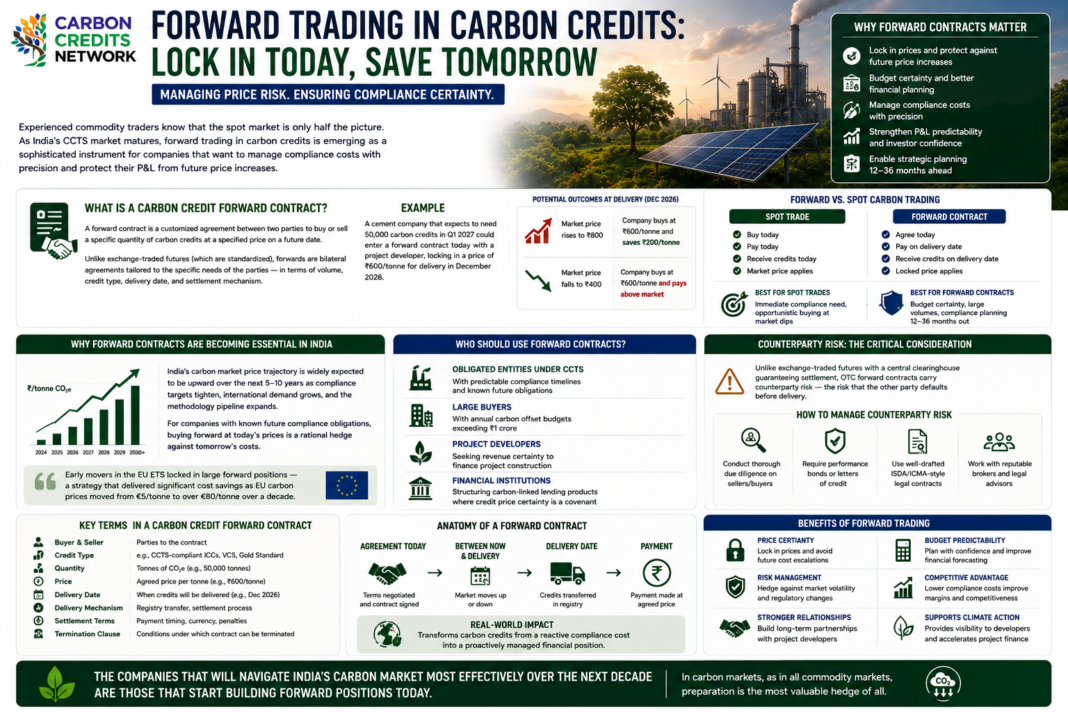
Experienced commodity traders know that the spot market is only half the picture. As India’s CCTS market matures, forward trading in carbon credits is emerging as a sophisticated instrument for companies that want to manage compliance costs with precision and protect their P&L from future price increases.
What Is a Carbon Credit Forward Contract?
A forward contract is a customized agreement between two parties to buy or sell a specific quantity of carbon credits at a specified price on a future date. Unlike exchange-traded futures (which are standardized), forwards are bilateral agreements tailored to the specific needs of the parties — in terms of volume, credit type, delivery date, and settlement mechanism.
For example: a cement company that expects to need 50,000 carbon credits in Q1 2027 could enter a forward contract today with a project developer, locking in a price of ₹600/tonne for delivery in December 2026. If market prices rise to ₹800/tonne by then, the cement company benefits from its hedge. If prices fall to ₹400/tonne, it pays above-market — the cost of the insurance it purchased against price risk.
⚖️ Forward vs. Spot Carbon Trading
Spot Trade: Buy today · Pay today · Receive credits today · Market price applies
Forward Contract: Agree today · Pay on delivery date · Locked price applies
Best for spots: Immediate compliance need, opportunistic buying at market dips
Best for forwards: Budget certainty, large volumes, compliance planning 12–36 months out
Why Forward Contracts Are Becoming Essential in India
India’s carbon market price trajectory is widely expected to be upward over the next 5–10 years as compliance targets tighten, international demand grows, and the methodology pipeline expands. For companies with known future compliance obligations, buying forward at today’s prices is a rational hedge against tomorrow’s costs. This is precisely the logic that drove early movers in the EU ETS to lock in large forward positions — a strategy that delivered significant cost savings as EU carbon prices moved from €5/tonne to over €80/tonne over a decade.
Who Should Use Forward Contracts?
Forward contracts are most appropriate for obligated entities under the CCTS with predictable compliance timelines; large buyers with annual carbon offset budgets exceeding ₹1 crore; project developers seeking revenue certainty to finance project construction; and financial institutions structuring carbon-linked lending products where credit price certainty is a covenant condition.
Counterparty Risk: The Critical Consideration
Unlike exchange-traded futures with a central clearinghouse guaranteeing settlement, OTC forward contracts carry counterparty risk — the risk that the other party defaults before delivery. In India’s early-stage market, buyers should conduct due diligence on sellers, require performance bonds or letters of credit for large forward positions, and engage legal counsel experienced in carbon market contracts.
Forward contracts transform carbon credits from a reactive compliance cost into a proactively managed financial position. The companies that will navigate India’s carbon market most effectively over the next decade are those that start building forward positions today — not those that scramble to buy at spot prices when compliance deadlines approach. In carbon markets, as in all commodity markets, preparation is the most valuable hedge of all.