For a tonne of CO₂e avoided or sequestered to generate a tradeable carbon credit under the CCTS framework, it must be measured and verified using an approved methodology. Understanding how methodology approval works is essential for any project developer, buyer, or policy observer engaged with India’s carbon market.
What Is a Carbon Credit Methodology?
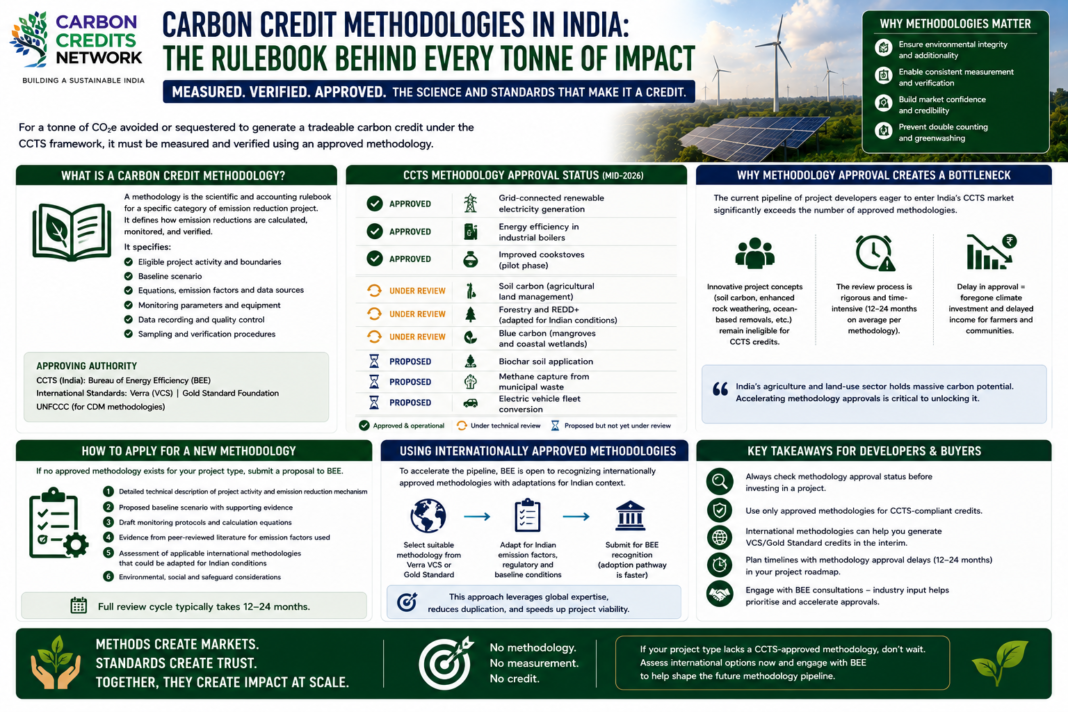
A methodology is the scientific and accounting rulebook for a specific category of emission reduction project. It specifies the eligible project activity, the baseline scenario, the equations and emission factors used to calculate reductions, the monitoring parameters, equipment specifications, data recording requirements, and the sampling strategies for verification audits. Under CCTS, the approving authority is BEE. Under international standards, it is Verra, the Gold Standard Foundation, or the UNFCCC for CDM methodologies.
📋 CCTS Methodology Approval Status (mid-2026)
✅ Approved: Grid-connected renewable electricity generation
✅ Approved: Energy efficiency in industrial boilers
✅ Approved: Improved cookstoves (pilot phase)
🔄 Under Review: Soil carbon (agricultural land management)
🔄 Under Review: Forestry and REDD+ (adapted for Indian conditions)
🔄 Under Review: Blue carbon (mangroves and coastal wetlands)
⏳ Proposed: Biochar soil application
⏳ Proposed: Methane capture from municipal waste
⏳ Proposed: Electric vehicle fleet conversion
Why Methodology Approval Creates a Bottleneck
The current pipeline of project developers eager to enter India’s CCTS market significantly exceeds the number of approved methodologies. Developers with innovative project concepts — soil carbon through precision agriculture, enhanced rock weathering, ocean-based carbon removal — find themselves unable to generate CCTS-compliant credits because no approved methodology yet exists for their activity. In India’s case, the breadth of the agricultural and land-use carbon opportunity means the delay in methodology approval represents a significant real-world cost in foregone climate investment and delayed income for farmers.
How to Apply for a New Methodology
If no approved methodology exists for your project type, you can submit a methodology proposal to BEE. The proposal must include: a detailed technical description of the project activity and its emission reduction mechanism; a proposed baseline scenario with supporting evidence; draft monitoring protocols and equations; evidence from peer-reviewed literature supporting the emission factors used; and an assessment of applicable international methodologies that could be adapted for Indian conditions. The full review cycle typically takes 12–24 months.
Using Internationally Approved Methodologies
To accelerate the methodology pipeline, BEE has indicated openness to recognizing internationally approved methodologies from Verra’s VCS library or the Gold Standard — with adaptations for Indian emission factors and regulatory context. This “methodology adoption” pathway is faster than developing new methodologies from scratch and draws on the global carbon market’s accumulated technical expertise.
If your project type lacks a CCTS-approved methodology, don’t wait — assess whether an international Verra or Gold Standard methodology could work for your project now while BEE finalizes domestic approval. This dual-track approach allows you to generate internationally recognized credits in the near term while positioning for CCTS credit issuance once domestic approval is granted.