
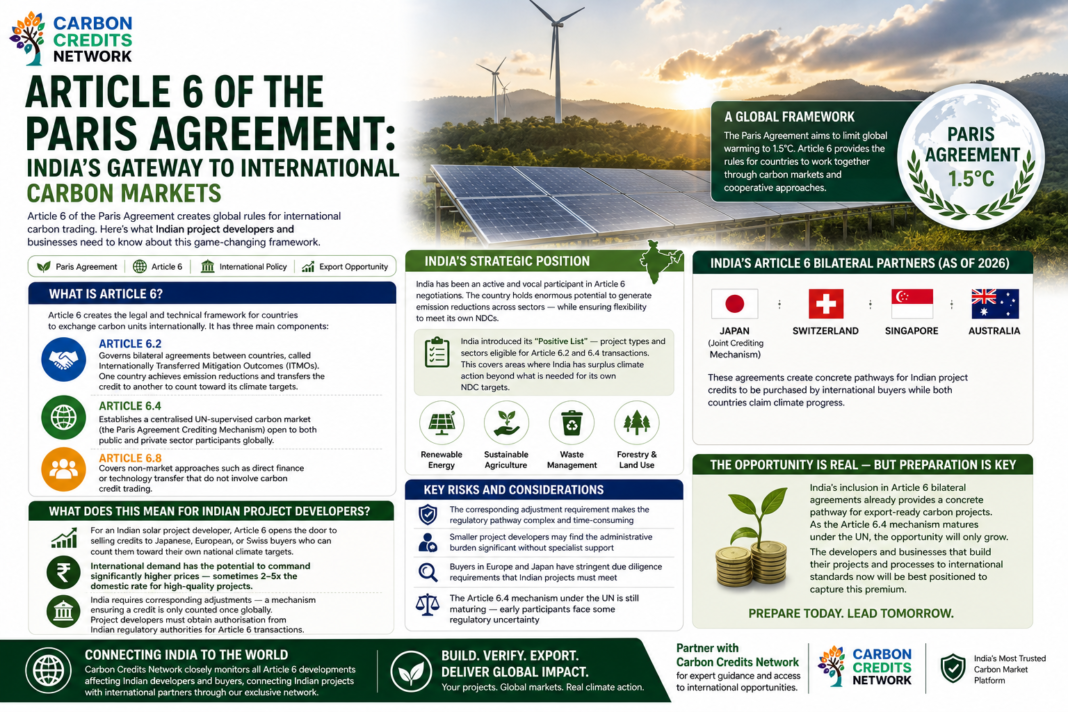
Article 6 of the Paris Agreement creates global rules for international carbon trading. Here’s what Indian project developers and businesses need to know about this game-changing framework.
Paris AgreementArticle 6InternationalPolicyExport
When world leaders signed the Paris Agreement in 2015, they set a collective target of limiting global warming to 1.5°C above pre-industrial levels. But they left one crucial question unanswered: how would countries work together on carbon trading across borders? It took until COP26 in Glasgow and subsequent negotiations to establish the rules under Article 6 — and India is one of the countries with the most to gain.
What Is Article 6?
Article 6 creates the legal and technical framework for countries to exchange carbon units internationally. It has three main components:
- Article 6.2 — Governs bilateral agreements between countries, called Internationally Transferred Mitigation Outcomes (ITMOs). One country achieves emission reductions and transfers the credit to another to count toward its climate targets.
- Article 6.4 — Establishes a centralised UN-supervised carbon market (the Paris Agreement Crediting Mechanism) open to both public and private sector participants globally.
- Article 6.8 — Covers non-market approaches such as direct finance or technology transfer that do not involve carbon credit trading.
India’s Strategic Position
India has been an active and vocal participant in Article 6 negotiations. The country holds enormous potential to generate emission reductions across renewable energy, forests, agriculture, and industry — with a strong interest in ensuring international buyers can finance these reductions while India retains flexibility to meet its own NDCs.
India introduced its “Positive List” — project types and sectors eligible for Article 6.2 and 6.4 transactions. This covers areas where India has surplus climate action beyond what is needed for its own NDC targets, including certain renewable energy types, sustainable agriculture, waste management, and select forestry activities.
India’s Article 6 Bilateral Partners (as of 2026):
🇯🇵 Japan (Joint Crediting Mechanism) · 🇨🇭 Switzerland · 🇸🇬 Singapore · 🇦🇺 Australia
These agreements create concrete pathways for Indian project credits to be purchased by international buyers while both countries claim climate progress.
What Does This Mean for Indian Project Developers?
For an Indian solar project developer, Article 6 opens the door to selling credits to Japanese, European, or Swiss buyers who can count them toward their own national climate targets. International demand has the potential to command significantly higher prices than purely domestic voluntary market transactions — sometimes 2–5x the domestic rate for high-quality projects.
However, participation in Article 6 is not simple. India requires corresponding adjustments — a mechanism ensuring a credit is only counted once globally, either by India for its NDC or by the purchasing country. Project developers must work with Indian regulatory authorities to obtain authorisation for Article 6 transactions.
Key Risks and Considerations
- The corresponding adjustment requirement makes the regulatory pathway complex and time-consuming
- Smaller project developers may find the administrative burden significant without specialist support
- Buyers in Europe and Japan have stringent due diligence requirements that Indian projects must meet
- The Article 6.4 mechanism under the UN is still maturing — early participants face some regulatory uncertainty
The Opportunity Is Real — But Preparation Is Key
India’s inclusion in Article 6 bilateral agreements already provides a concrete pathway for export-ready carbon projects. As the Article 6.4 mechanism matures under the UN, the opportunity will only grow. The developers and businesses that build their projects and processes to international standards now will be best positioned to capture this premium.
India’s Gateway to International Carbon Markets
Carbon Credits Network closely monitors all Article 6 developments affecting Indian developers and buyers, connecting Indian projects with international partners through our exclusive network.