
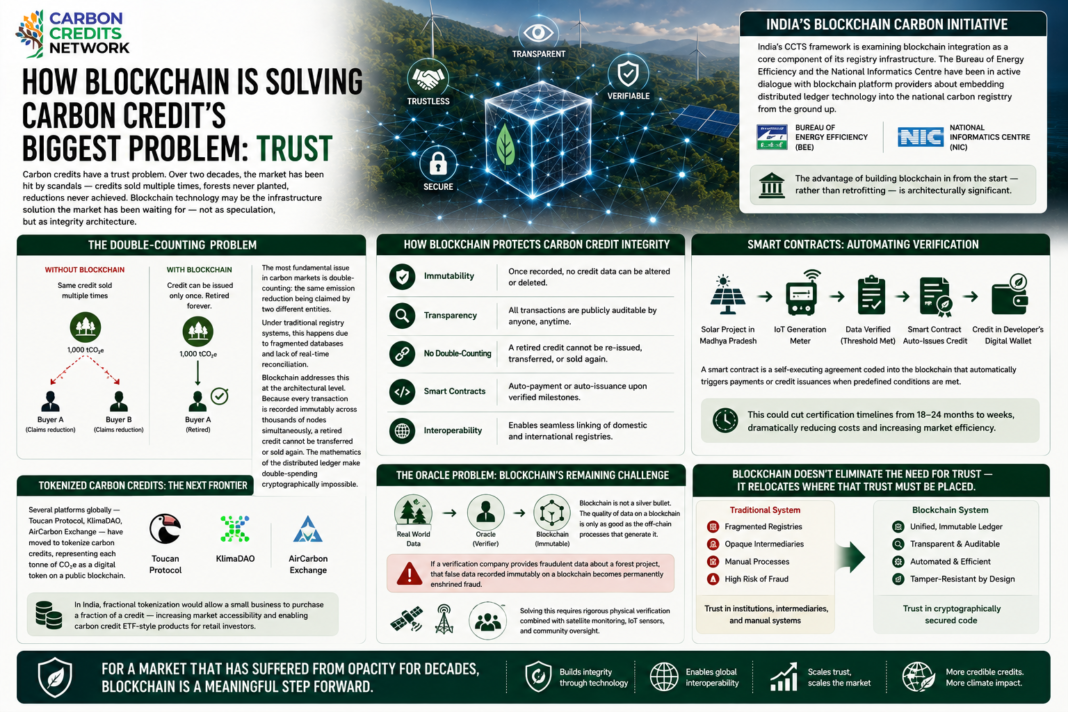
Carbon credits have a trust problem. Over two decades, the market has been hit by scandals — credits sold multiple times, forests never planted, reductions never achieved. Blockchain technology may be the infrastructure solution the market has been waiting for — not as speculation, but as integrity architecture.
The Double-Counting Problem
The most fundamental issue in carbon markets is double-counting: the same emission reduction being claimed by two different entities. Under traditional registry systems, this happens due to fragmented databases and lack of real-time reconciliation. Blockchain addresses this at the architectural level. Because every transaction is recorded immutably across thousands of nodes simultaneously, a retired credit cannot be transferred or sold again. The mathematics of the distributed ledger make double-spending cryptographically impossible.
India’s Blockchain Carbon Initiative
India’s CCTS framework is examining blockchain integration as a core component of its registry infrastructure. The Bureau of Energy Efficiency and the National Informatics Centre have been in active dialogue with blockchain platform providers about embedding distributed ledger technology into the national carbon registry from the ground up. The advantage of building blockchain in from the start — rather than retrofitting — is architecturally significant.
⛓️ How Blockchain Protects Carbon Credit Integrity
Immutability: Once recorded, no credit data can be altered
Transparency: All transactions are publicly auditable
No Double-Counting: A retired credit cannot be re-issued
Smart Contracts: Auto-payment upon verified milestones
Interoperability: Links domestic and international registries
Smart Contracts: Automating Verification
A smart contract is a self-executing agreement coded into the blockchain that automatically triggers payments or credit issuances when predefined conditions are met. Imagine a solar project in Madhya Pradesh connected to an IoT generation meter. When generation data passes a verification threshold, a smart contract automatically issues the corresponding carbon credit to the developer’s digital wallet — no manual verification, no months-long paperwork delay. This could cut certification timelines from 18–24 months to weeks.
Tokenized Carbon Credits: The Next Frontier
Several platforms globally — Toucan Protocol, KlimaDAO, and AirCarbon Exchange — have moved to tokenize carbon credits, representing each tonne of CO₂e as a digital token on a public blockchain. In India, fractional tokenization would allow a small business to purchase a fraction of a credit — increasing market accessibility and enabling carbon credit ETF-style products for retail investors.
The Oracle Problem: Blockchain’s Remaining Challenge
Blockchain is not a silver bullet. The quality of data on a blockchain is only as good as the off-chain processes that generate it. If a verification company provides fraudulent data about a forest project, that false data recorded immutably on a blockchain becomes permanently enshrined fraud. Solving this requires rigorous physical verification combined with satellite monitoring, IoT sensors, and community oversight.
Blockchain doesn’t eliminate the need for trust in carbon markets — it relocates where that trust must be placed. Instead of trusting fragmented registries and opaque intermediaries, market participants trust cryptographically secured code. For a market that has suffered from opacity for decades, this is a meaningful step forward.