
India’s carbon credit market is no longer reserved for boardrooms. With the CCTS rolling out in phases through 2026, businesses, farmers, and investors are asking: how is the price of a carbon credit actually set? The answer is more nuanced — and commercially interesting — than most expect.
A single carbon credit represents the verified reduction or removal of one metric tonne of carbon dioxide equivalent (CO₂e) from the atmosphere. Unlike gold or wheat, carbon credits don’t carry a fixed global price. Their value is shaped by a complex interplay of policy, demand, and project quality. In India’s emerging framework, prices are expected to range between ₹200 and ₹1,000 per tonne initially — mirroring the early-stage trajectories of the EU and China carbon markets.
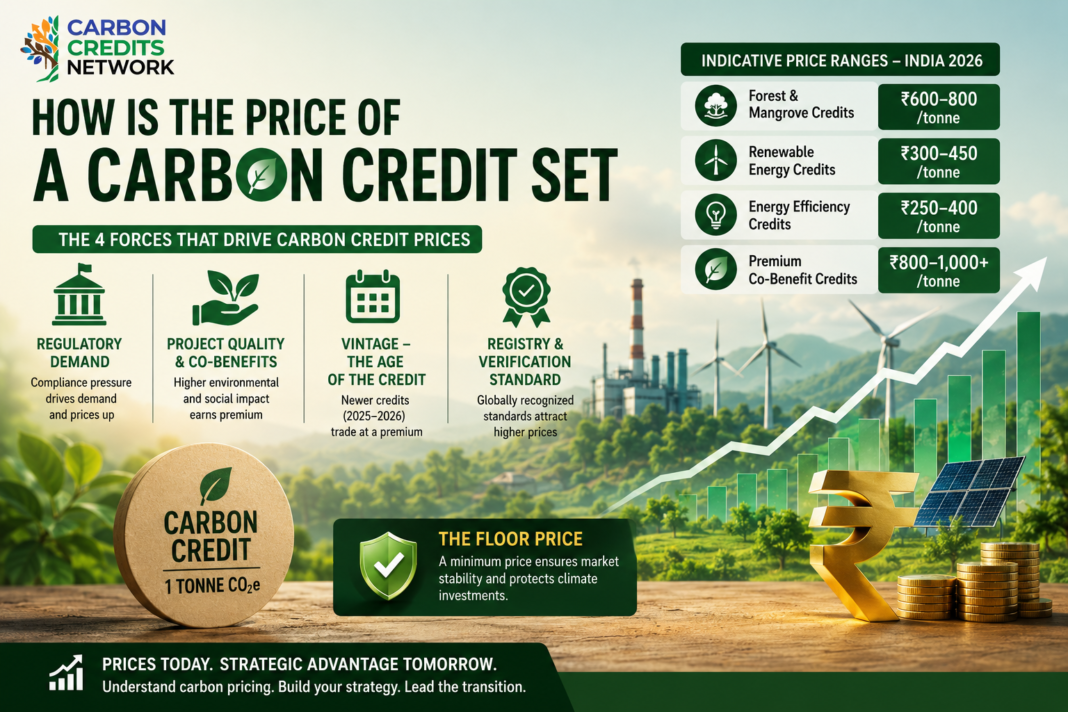
The Four Forces That Drive the Price
1. Regulatory Demand (Compliance Pressure): When the government mandates that industries must reduce emissions or buy credits, guaranteed demand is created. India’s Bureau of Energy Efficiency (BEE) sets the performance standards, and as targets tighten annually toward India’s 2030 NDC milestones, both demand and price will systematically rise.
2. Project Quality and Co-Benefits: A reforestation project in the Western Ghats that simultaneously protects biodiversity, creates tribal livelihoods, and restores watersheds commands a meaningful premium over a generic renewable energy credit. Buyers with strong ESG commitments pay more for credits with verified social and ecological co-benefits.
3. Vintage — The Age of the Credit: Credits issued from older projects are frequently discounted. Fresh 2025–2026 vintage credits from new methodologies trade at a premium because they reflect the most current accounting standards.
4. Registry and Verification Standard: Credits verified under the Gold Standard or Verra’s VCS — internationally recognized frameworks — trade above domestically-issued credits. As India’s CCTS matures, this pricing gap is expected to narrow substantially.
📊 Indicative Price Ranges — India Carbon Market 2026
Forest & Mangrove Credits: ₹600–800/tonne
Renewable Energy Credits: ₹300–450/tonne
Energy Efficiency Credits: ₹250–400/tonne
Premium Co-Benefit Credits: ₹800–1,000+/tonne
The Floor Price: India’s Market Safety Net
One of the most strategically significant features of the CCTS framework is the introduction of a floor price — a minimum below which carbon credits cannot be traded. This protects project developers from market crashes and ensures climate investment remains viable even during macroeconomic downturns. Think of it as a Reserve Bank of India-style buffer, but for green assets.
What This Means for Businesses
If you run a manufacturing unit, hotel, logistics company, or data centre in India, carbon credit prices directly affect your compliance costs. A price of ₹500/tonne may seem manageable today, but with India’s net zero target by 2070 and tightening interim milestones, prices are widely projected to increase 3–5x over the next decade. Build your carbon strategy now — not when compliance deadlines force your hand.
What This Means for Project Developers
For those developing renewable energy, biochar, improved cookstove, or afforestation projects, today’s prices offer a concrete preview of revenue potential. A 10,000-tonne-per-year project at ₹800/tonne generates ₹80 lakh annually in carbon revenue — often the margin that makes a project bankable.
India’s carbon credit price reflects the real cost of climate inaction and the scarcity of verified climate solutions. As regulations tighten and global demand accelerates, early movers in the Indian carbon market will benefit most. Understanding pricing is no longer optional — it’s a competitive advantage.