
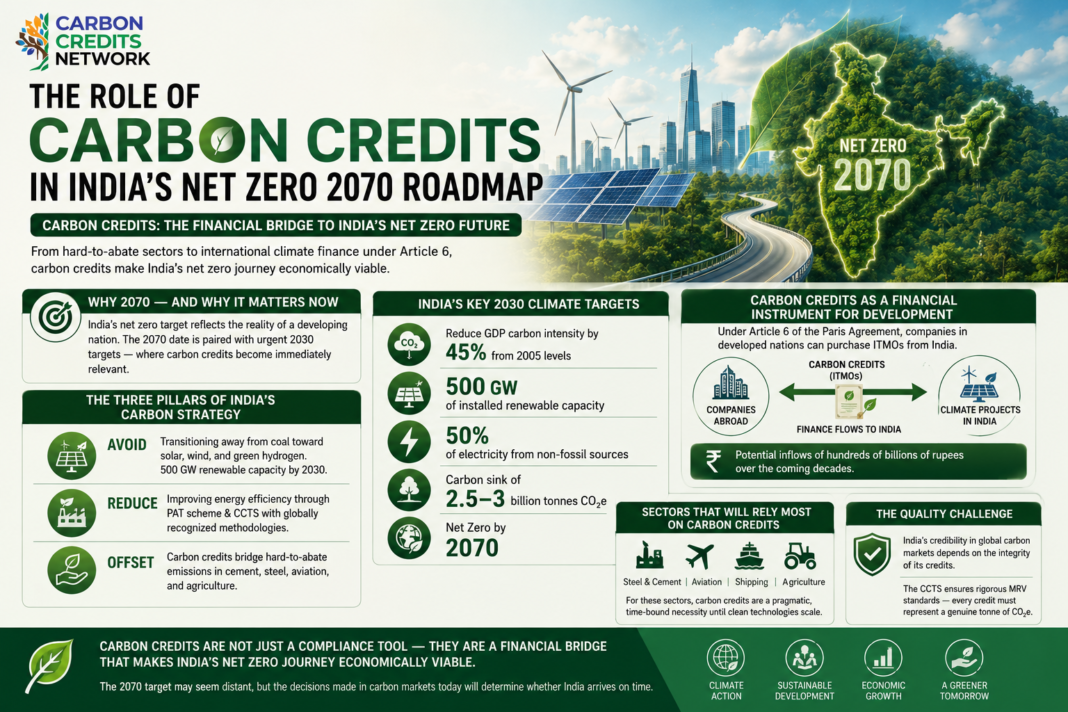
In 2021, India pledged net zero by 2070 at COP26 — placing the carbon credit market at the centre of India’s long-term climate strategy. From hard-to-abate sectors to international climate finance under Article 6, carbon credits are the financial bridge that makes this journey economically viable.
Why 2070 — And Why It Matters Now
India’s net zero target reflects the reality of a developing nation still lifting hundreds of millions out of energy poverty. The 2070 date was paired with urgent 2030 targets: reducing GDP carbon intensity by 45%, achieving 50% of power capacity from renewables, and creating an additional carbon sink of 2.5–3 billion tonnes through forests and ecosystems. These 2030 targets are where carbon credits become immediately relevant.
The Three Pillars of India’s Carbon Strategy
Avoid: Transitioning away from coal toward solar, wind, and green hydrogen. India is targeting 500 GW of renewable capacity by 2030 — requiring unprecedented investment and policy support.
Reduce: Making existing industries more energy-efficient through the PAT scheme and the new CCTS framework, introducing internationally recognized methodologies for a broader set of sectors.
Offset: For emissions that cannot yet be eliminated — from cement, steel, aviation, and agriculture — carbon credits provide a financially viable bridge to the clean energy future.
🎯 India’s Key 2030 Climate Targets
• Reduce GDP carbon intensity by 45% from 2005 levels
• 500 GW of installed renewable capacity
• 50% of electricity from non-fossil sources
• Carbon sink of 2.5–3 billion tonnes CO₂e
• Net Zero by 2070
Carbon Credits as a Financial Instrument for Development
Under Article 6 of the Paris Agreement, companies in wealthy nations can purchase “internationally transferred mitigation outcomes” (ITMOs) from India. A Japanese steel company reducing its regulatory carbon bill can fund a solar microgrid project in Rajasthan. Money flows from developed to developing nations — not as aid, but as a market transaction representing hundreds of billions of rupees in potential inflows over the coming decades.
Sectors That Will Rely Most on Carbon Credits
“Hard-to-abate” sectors will rely heavily on offsets during the transition: steel and cement production; long-distance aviation and shipping; and agriculture and livestock. For these sectors, carbon credits aren’t a loophole — they’re a pragmatic, time-bound necessity until breakthrough technologies scale.
The Quality Challenge
India’s credibility in international carbon markets depends entirely on the integrity of its credits. The CCTS framework introduces rigorous MRV standards to ensure every credit represents a genuine tonne of CO₂e — a commitment that will define India’s reputation as a carbon supplier for decades.
Carbon credits are not just a compliance tool — they are a financial bridge that makes India’s net zero journey economically viable. The 2070 target may seem distant, but the decisions made in carbon markets today will determine whether India arrives on time.