
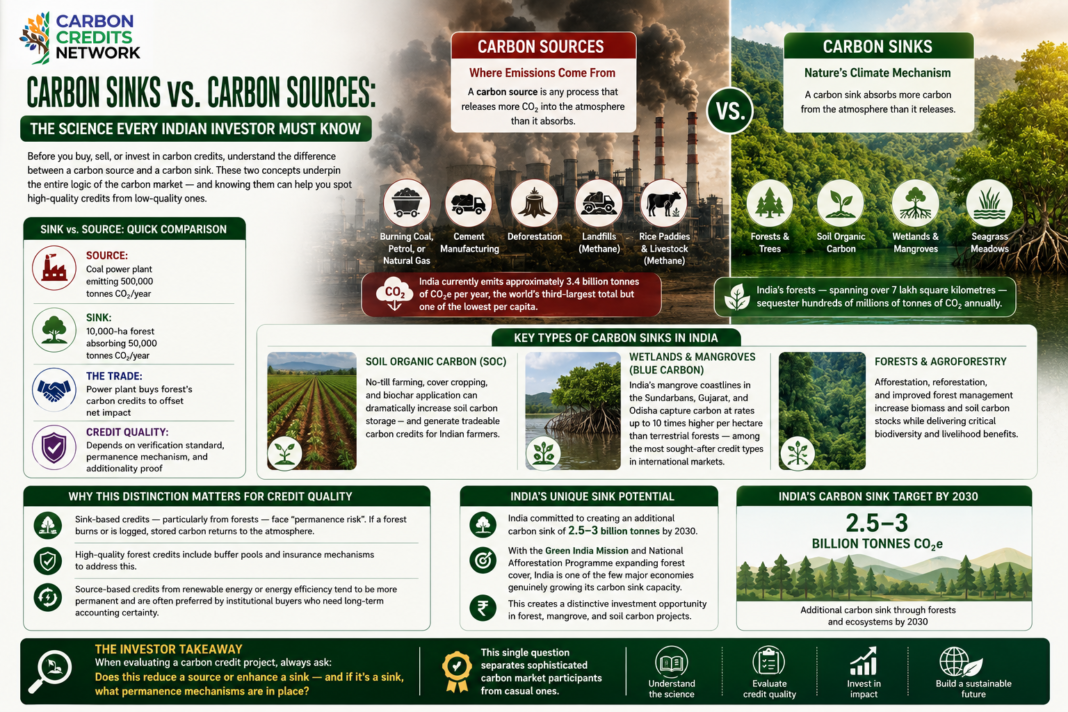
Before you buy, sell, or invest in carbon credits, understand the difference between a carbon source and a carbon sink. These two concepts underpin the entire logic of the carbon market — and knowing them can help you spot high-quality credits from low-quality ones.
Carbon Sources: Where Emissions Come From
A carbon source is any process that releases more CO₂ into the atmosphere than it absorbs. This includes burning coal, petrol, or natural gas; cement manufacturing; deforestation; landfills generating methane; and rice paddies and livestock — major agricultural sources of methane in India. India currently emits approximately 3.4 billion tonnes of CO₂e per year, the world’s third-largest total but one of the lowest per capita.
Carbon Sinks: Nature’s Climate Mechanism
A carbon sink absorbs more carbon from the atmosphere than it releases. India’s forests — spanning over 7 lakh square kilometres — sequester hundreds of millions of tonnes of CO₂ annually. Key sink types include:
Soil Organic Carbon (SOC): No-till farming, cover cropping, and biochar application can dramatically increase soil carbon storage — and generate tradeable carbon credits for Indian farmers.
Wetlands and Mangroves (Blue Carbon): India’s mangrove coastlines in the Sundarbans, Gujarat, and Odisha capture carbon at rates up to 10 times higher per hectare than terrestrial forests — among the most sought-after credit types in international markets.
🌿 Sink vs. Source Quick Comparison
Source: Coal power plant emitting 500,000 tonnes CO₂/year
Sink: 10,000-ha forest absorbing 50,000 tonnes CO₂/year
The Trade: Power plant buys forest’s carbon credits to offset net impact
Credit Quality: Depends on verification standard, permanence mechanism, and additionality proof
Why This Distinction Matters for Credit Quality
Sink-based credits — particularly from forests — face “permanence risk”: if a forest burns or is logged, stored carbon returns to the atmosphere. High-quality forest credits include buffer pools and insurance mechanisms to address this. Source-based credits from renewable energy or energy efficiency tend to be more permanent and are often preferred by institutional buyers who need long-term accounting certainty.
India’s Unique Sink Potential
India committed to creating an additional carbon sink of 2.5–3 billion tonnes by 2030. With the Green India Mission and National Afforestation Programme expanding forest cover, India is one of the few major economies genuinely growing its carbon sink capacity — creating a distinctive investment opportunity in forest, mangrove, and soil carbon projects.
When evaluating a carbon credit project, always ask: does this reduce a source or enhance a sink — and if it’s a sink, what permanence mechanisms are in place? This single question separates sophisticated carbon market participants from casual ones.