
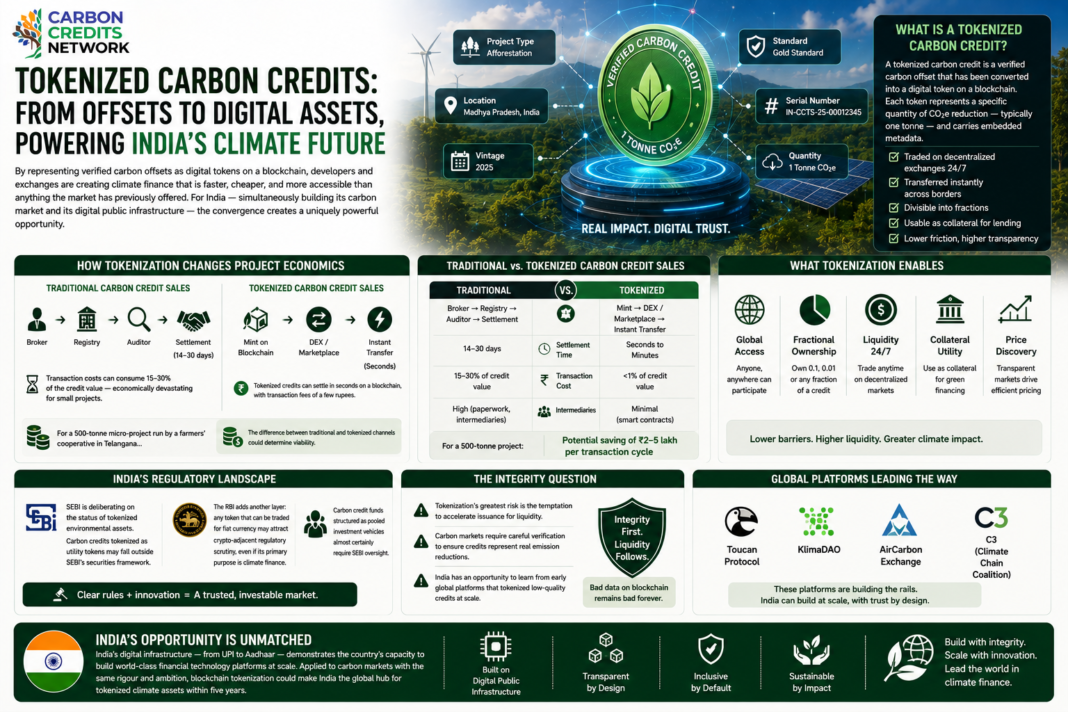
By representing verified carbon offsets as digital tokens on a blockchain, developers and exchanges are creating climate finance that is faster, cheaper, and more accessible than anything the market has previously offered. For India — simultaneously building its carbon market and its digital public infrastructure — the convergence creates a uniquely powerful opportunity.
What Is a Tokenized Carbon Credit?
A tokenized carbon credit is a verified carbon offset that has been converted into a digital token on a blockchain. Each token represents a specific quantity of CO₂e reduction — typically one tonne — and carries embedded metadata: the project type, location, vintage year, verification standard, and unique serial number. Once tokenized, the credit can be traded on decentralized exchanges 24/7, transferred instantly across borders, divided into fractions, and used as collateral for lending — all without the friction of traditional registry systems.
How Tokenization Changes Project Economics
Traditional carbon credit sales involve a broker, registry, multiple verification steps, and settlement times of days to weeks. Transaction costs can consume 15–30% of the credit value — economically devastating for small projects. Tokenized credits can settle in seconds on a blockchain, with transaction fees of a few rupees. For a 500-tonne micro-project run by a farmers’ cooperative in Telangana, the difference between traditional and tokenized channels could determine viability.
⚡ Traditional vs. Tokenized Carbon Credit Sales
Traditional: Broker → Registry → Auditor → Settlement (14–30 days) · Cost: 15–30% of credit value
Tokenized: Mint → DEX/Marketplace → Instant Transfer · Cost: <1% of credit value
For a 500-tonne project: Potential saving of ₹2–5 lakh per transaction cycle
India’s Regulatory Landscape
SEBI is deliberating on the status of tokenized environmental assets. Carbon credits tokenized as utility tokens may fall outside SEBI’s securities framework. But carbon credit funds structured as pooled investment vehicles almost certainly require SEBI oversight. The RBI adds another layer: any token that can be traded for fiat currency may attract crypto-adjacent regulatory scrutiny, even if its primary purpose is climate finance.
The Integrity Question
Tokenization’s greatest risk is the temptation to accelerate issuance for liquidity. Carbon markets require careful verification to ensure credits represent real emission reductions. India has an opportunity to learn from early global platforms that tokenized low-quality credits at scale — creating “carbon tokens” that destroyed rather than built market trust.
India’s digital infrastructure — from UPI to Aadhaar — demonstrates the country’s capacity to build world-class financial technology platforms at scale. Applied to carbon markets with the same rigour and ambition, blockchain tokenization could make India the global hub for tokenized climate assets within five years. But only if integrity leads the way.