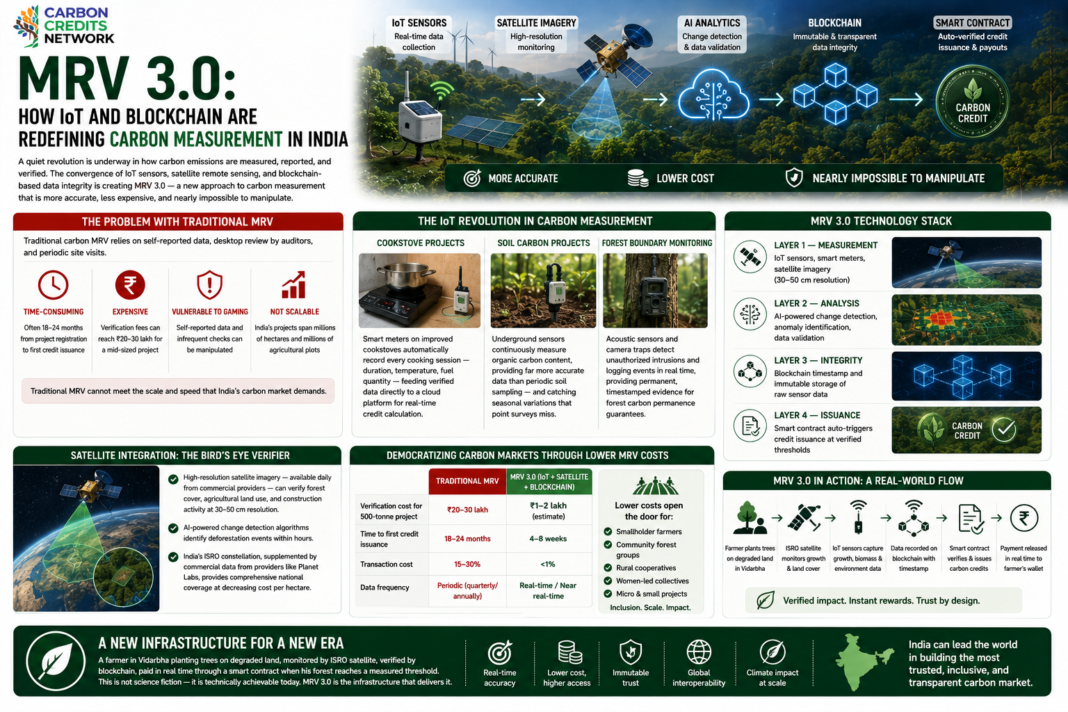
A quiet revolution is underway in how carbon emissions are measured, reported, and verified. The convergence of IoT sensors, satellite remote sensing, and blockchain-based data integrity is creating MRV 3.0 — a new approach to carbon measurement that is more accurate, less expensive, and nearly impossible to manipulate.
The Problem with Traditional MRV
Traditional carbon MRV relies on self-reported data, desktop review by auditors, and periodic site visits. The process is time-consuming (often 18–24 months from project registration to first credit issuance), expensive (verification fees can reach ₹20–30 lakh for a mid-sized project), and vulnerable to gaming. In India, where carbon projects span millions of hectares of forest and millions of agricultural plots, traditional MRV is simply not scalable at the pace the market requires.
The IoT Revolution in Carbon Measurement
Cookstove Projects: Smart meters on improved cookstoves automatically record every cooking session — duration, temperature, fuel quantity — feeding verified data directly to a cloud platform for real-time credit calculation.
Soil Carbon Projects: Underground sensors continuously measure organic carbon content, providing far more accurate data than periodic soil sampling — and catching seasonal variations that point surveys miss.
Forest Boundary Monitoring: Acoustic sensors and camera traps detect unauthorized intrusions and logging events in real time, providing permanent, timestamped evidence for forest carbon permanence guarantees.
📡 MRV 3.0 Technology Stack
Layer 1 — Measurement: IoT sensors, smart meters, satellite imagery (30–50 cm resolution)
Layer 2 — Analysis: AI-powered change detection, anomaly identification, data validation
Layer 3 — Integrity: Blockchain timestamp and immutable storage of raw sensor data
Layer 4 — Issuance: Smart contract auto-triggers credit issuance at verified thresholds
Satellite Integration: The Bird’s Eye Verifier
High-resolution satellite imagery — available at daily frequency from commercial providers — can verify forest cover, agricultural land use, and construction activity at 30–50 centimetre resolution. AI-powered change detection algorithms identify deforestation events within hours. India’s ISRO constellation, supplemented by commercial data from providers like Planet Labs, provides comprehensive national coverage at decreasing cost per hectare.
Democratizing Carbon Markets Through Lower MRV Costs
As sensor costs decline and satellite data becomes commodity-priced, the cost of verifying a small 500-tonne project drops from ₹20+ lakh to a fraction of that. This makes carbon markets genuinely accessible to smallholder farmers, community forest groups, and rural cooperatives previously priced out by the economics of traditional verification.
A farmer in Vidarbha planting trees on degraded land, monitored by ISRO satellite, verified by blockchain, paid in real time through a smart contract when his forest reaches a measured threshold. This is not science fiction — it is technically achievable today. MRV 3.0 is the infrastructure that delivers it.