
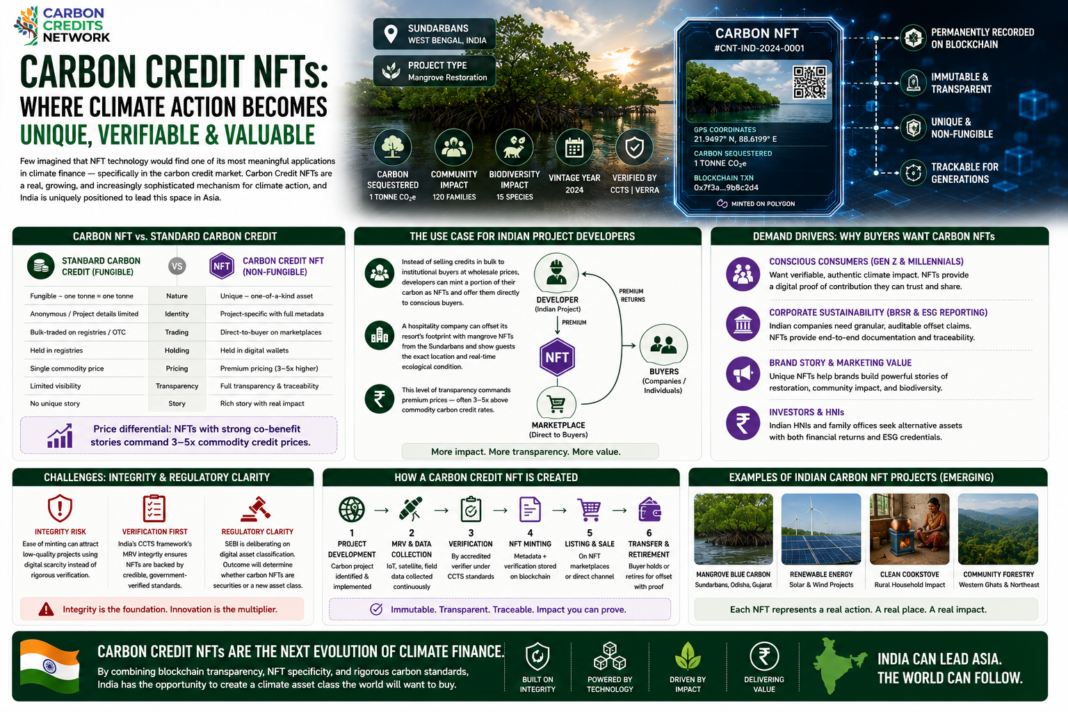
Few imagined that NFT technology would find one of its most meaningful applications in climate finance — specifically in the carbon credit market. Carbon Credit NFTs are a real, growing, and increasingly sophisticated mechanism for climate action, and India is uniquely positioned to lead this space in Asia.
What Makes a Carbon NFT Different from a Standard Carbon Credit?
A standard carbon credit is a fungible asset: one tonne of CO₂e reduction from a solar project in Rajasthan is interchangeable with one tonne from a clean cookstove project in Odisha. This fungibility erases the unique story and attributes of each project. A Carbon Credit NFT is fundamentally different — a non-fungible token representing a specific, one-of-a-kind climate action, with all its attributes encoded, verified, and permanently attached. An NFT might represent the carbon sequestered by a specific grove of mangroves in the Sundarbans, complete with GPS coordinates, biodiversity survey data, satellite imagery, and community impact reports.
🎨 Carbon NFT vs. Standard Carbon Credit
Standard Credit: Fungible · Anonymous · Bulk-traded · Registry-held · Single price tier
Carbon NFT: Unique · Project-specific · Direct-to-buyer · Wallet-held · Premium pricing
Price differential: NFTs with strong co-benefit stories command 3–5x commodity credit prices
The Use Case for Indian Project Developers
Instead of selling credits in bulk to institutional buyers at wholesale prices, developers can mint a portion of their carbon as NFTs and offer them directly to environmentally conscious consumers and corporate buyers who want to tell a specific, verifiable story. A hospitality company offsetting its resort’s footprint with mangrove NFTs from the Sundarbans can show guests the exact location and real-time ecological condition of the forest their stay helped protect. This level of transparency commands premium prices — often 3–5x above commodity carbon credit rates.
Consumer and Corporate Demand Drivers
Gen Z and millennial consumers make purchasing decisions based on verifiable environmental impact. Corporate sustainability reporting under BRSR requirements is pushing Indian companies toward more granular and auditable offset claims — exactly the documentation trail that NFTs provide. India’s growing HNI and family office investor segment is also looking for alternative assets with both financial returns and ESG credentials.
Challenges: Integrity and Regulatory Clarity
The ease of minting tokens has attracted projects that use digital scarcity as a substitute for rigorous verification. India’s CCTS framework’s emphasis on MRV integrity provides an important foundation: carbon NFTs minted against CCTS-verified credits carry significantly more credibility than those issued without government-backed verification standards. SEBI’s ongoing deliberation on digital asset classification will also determine whether carbon NFTs constitute securities or a new asset class.
Carbon Credit NFTs are not a speculative novelty — they are the next evolution of how society accounts for and values climate action. By combining blockchain transparency, NFT specificity, and rigorous carbon standards, India has an opportunity to create a climate asset class the world will want to buy. The key is building on integrity first, innovation second.