
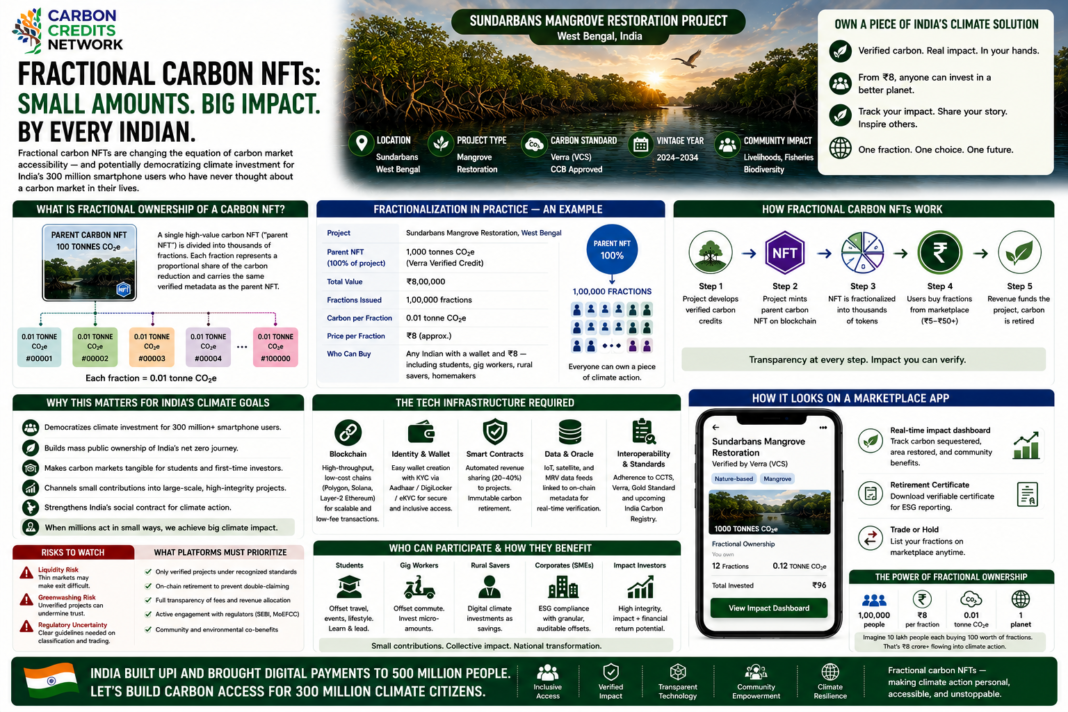
Fractional carbon NFTs are changing the equation of carbon market accessibility — and potentially democratizing climate investment for India’s 300 million smartphone users who have never thought about a carbon market in their lives.
What Is Fractional Ownership of a Carbon NFT?
Fractionalization divides a single high-value asset into smaller, more affordable units. A single “parent” NFT representing, say, 100 tonnes of verified carbon reduction from a mangrove restoration project can be divided into 10,000 fractions — each representing 0.01 tonnes of CO₂e reduction, purchasable for as little as ₹5–10. Each fraction is itself a blockchain-verified token, carrying all the metadata of the parent NFT: GPS coordinates, verification standard, satellite imagery link, and community impact data.
💡 Fractionalization in Practice — An Example
Project: Sundarbans Mangrove Restoration, West Bengal
Parent NFT Value: 1,000 tonnes CO₂e · ₹8,00,000 total
Fractions Issued: 1,00,000 fractions
Price per Fraction: ₹8 (representing 0.01 tonne CO₂e)
Who Can Buy: Any Indian with a crypto wallet and ₹8 — including students, gig workers, and rural savers
Why This Matters for India’s Climate Goals
India’s net zero commitment is ultimately a social contract — it requires not just industrial transformation but widespread public engagement with the concept of carbon responsibility. When a college student in Hyderabad can offset her month’s personal carbon footprint by spending ₹50 on verified fractional carbon NFTs, she doesn’t just reduce emissions — she becomes a participant in and advocate for the carbon market ecosystem.
The Technical Infrastructure Required
Fractional carbon NFT platforms need: a high-throughput, low-cost blockchain (Polygon, Solana, or Layer-2 Ethereum networks); a robust identity and wallet system that integrates with India’s digital infrastructure, ideally linking with Aadhaar or DigiLocker for KYC; and clear regulatory guidance from SEBI and MoEFCC on whether fractionalized carbon tokens constitute securities.
Risks: Liquidity, Greenwashing, and Regulatory Uncertainty
Liquidity in thin markets can make it difficult to exit a position — especially for micro-fractions of niche projects. Greenwashing risk is amplified when platforms issue fractional tokens against unverified projects. Platforms should prioritize: only projects verified under recognized standards, clear on-chain retirement records that prevent the same fraction from being claimed twice, and regulatory engagement rather than evasion.
India built UPI and gave 500 million people access to digital payments overnight. The country has the infrastructure ambition to do the same for climate finance. Fractional carbon NFTs are not an incremental improvement to existing carbon markets — they are a fundamentally new access layer that could make India’s net zero journey a genuinely participatory national project.