
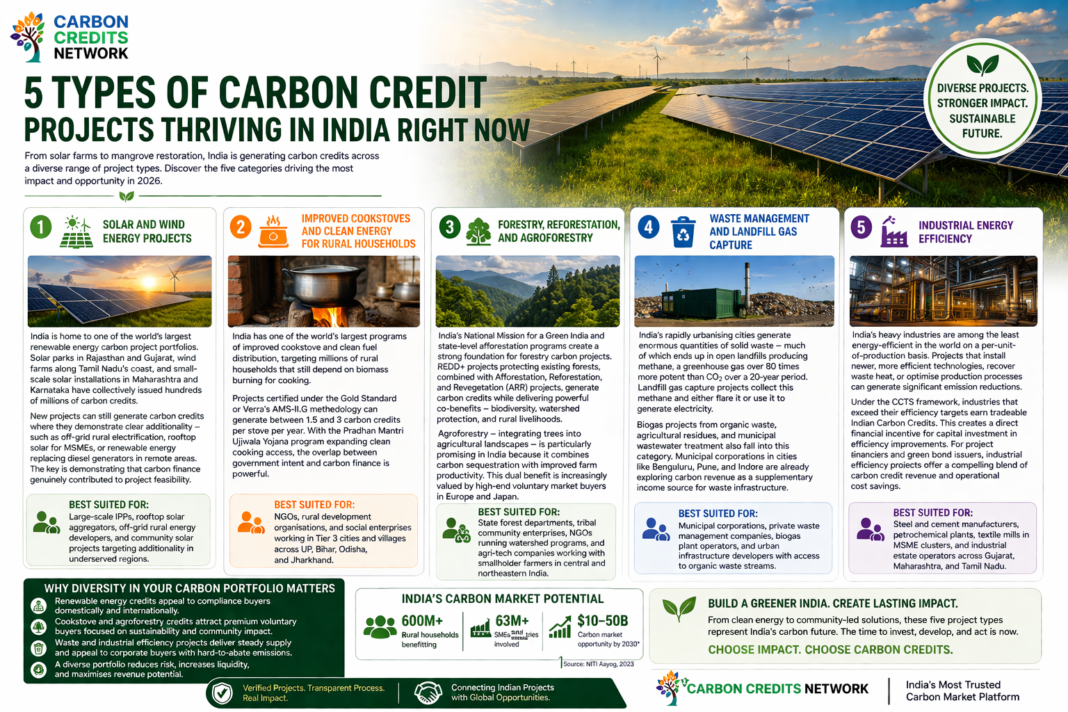
From solar farms to mangrove restoration, India is generating carbon credits across a diverse range of project types. Discover the five categories driving the most impact and opportunity in 2026.
Project TypesRenewable EnergyForestryAgricultureWaste
India’s carbon credit landscape is far more diverse than most people realise. While renewable energy projects dominate headline figures, the Indian carbon market is quietly producing a rich variety of emission reduction and carbon sequestration projects — each with its own methodology, opportunity, and buyer profile. Here are five categories that are thriving right now.
1. Solar and Wind Energy Projects
India is home to one of the world’s largest and most active renewable energy carbon project portfolios. Solar parks in Rajasthan and Gujarat, wind farms along Tamil Nadu’s coast, and small-scale solar installations in Maharashtra have collectively issued hundreds of millions of carbon credits over the past two decades.
Under the CCTS framework and voluntary standards, new renewable energy projects can still generate carbon credits — particularly in contexts where they demonstrate clear additionality, such as off-grid rural electrification, rooftop solar for MSMEs, or renewable energy replacing diesel generators in remote areas. The key is demonstrating that carbon finance genuinely contributed to project feasibility.
🌞 Best suited for: Large-scale IPPs, rooftop solar aggregators, off-grid rural energy developers, and community solar projects targeting additionality in underserved regions.
2. Improved Cookstoves and Clean Energy for Rural Households
India has one of the world’s largest programs of improved cookstove and clean fuel distribution, targeting millions of rural households that still depend on biomass burning for cooking. Each clean cookstove reduces emissions of CO₂ and black carbon — a potent short-lived climate forcer with outsized warming impact.
Projects certified under the Gold Standard or Verra’s AMS-II.G methodology can generate between 1.5 and 3 carbon credits per stove per year. With India’s Pradhan Mantri Ujjwala Yojana program expanding clean cooking access, the overlap between government intent and carbon finance creates powerful project opportunities — especially at community scale.
🍳 Best suited for: NGOs, rural development organisations, and social enterprises working in Tier 3 cities and villages across UP, Bihar, Odisha, and Jharkhand.
3. Forestry, Reforestation, and Agroforestry
India’s National Mission for a Green India and state-level afforestation programs create a strong foundation for forestry carbon projects. REDD+ (Reducing Emissions from Deforestation and Forest Degradation) projects protecting existing forests, combined with Afforestation, Reforestation, and Revegetation (ARR) projects creating new forests, generate carbon credits while delivering powerful co-benefits — biodiversity, watershed protection, and rural livelihoods.
Agroforestry — integrating trees into agricultural landscapes — is particularly promising in India because it combines carbon sequestration with improved farm productivity. This dual benefit is increasingly valued by high-end voluntary market buyers in Europe and Japan, who pay premium prices for projects with certified sustainable development co-benefits.
🌳 Best suited for: State forest departments, tribal community enterprises, NGOs running watershed programs, and agri-tech companies working with smallholder farmers in central and northeastern India.
4. Waste Management and Landfill Gas Capture
India’s rapidly urbanising cities generate enormous quantities of solid waste — much of which ends up in open landfills producing methane, a greenhouse gas over 80 times more potent than CO₂ over a 20-year period. Landfill gas capture projects collect this methane and either flare it (converting it to less harmful CO₂) or use it to generate electricity.
Biogas projects from organic waste, agricultural residues, and municipal wastewater treatment also fall into this category. With India’s Swachh Bharat Mission providing policy support for waste management infrastructure, the enabling environment for waste-to-carbon-credit projects has never been stronger. Municipal corporations in cities like Bengaluru, Pune, and Indore are already exploring carbon revenue as a supplementary income source for waste infrastructure.
♻️ Best suited for: Municipal corporations, private waste management companies, biogas plant operators, and urban infrastructure developers with access to organic waste streams.
5. Industrial Energy Efficiency
India’s heavy industries — steel, cement, chemicals, textiles — are among the least energy-efficient in the world on a per-unit-of-production basis. Projects that install newer, more efficient industrial technologies, recover waste heat, or optimise production processes can generate significant, measurable emission reductions.
Under the CCTS framework, industries that exceed their efficiency targets earn tradeable Indian Carbon Credits. This creates a direct financial incentive for capital investment in efficiency improvements. For project financiers and green bond issuers, industrial efficiency projects in India offer a compelling blend of carbon credit revenue and operational cost savings — making them among the most bankable project types in the current market.
🏭 Best suited for: Steel and cement manufacturers, petrochemical plants, textile mills in MSME clusters, and industrial estate operators across Gujarat, Maharashtra, and Tamil Nadu.
Why Diversity in Your Carbon Portfolio Matters
A diversified Indian carbon credit portfolio serves multiple market segments simultaneously. Renewable energy credits appeal to compliance buyers domestically and internationally. Cookstove and agroforestry credits attract premium voluntary buyers focused on sustainable development. Landfill and industrial credits serve domestic compliance needs at scale.
Investors and buyers who understand this diversity — and can access verified projects across all five categories — are best positioned to capture value as India’s carbon market deepens and price discovery improves.
Access India’s Most Diverse Carbon Project Portfolio
Carbon Credits Network provides exclusive access to verified projects across all five categories — with full documentation, direct developer connections, and expert market guidance.