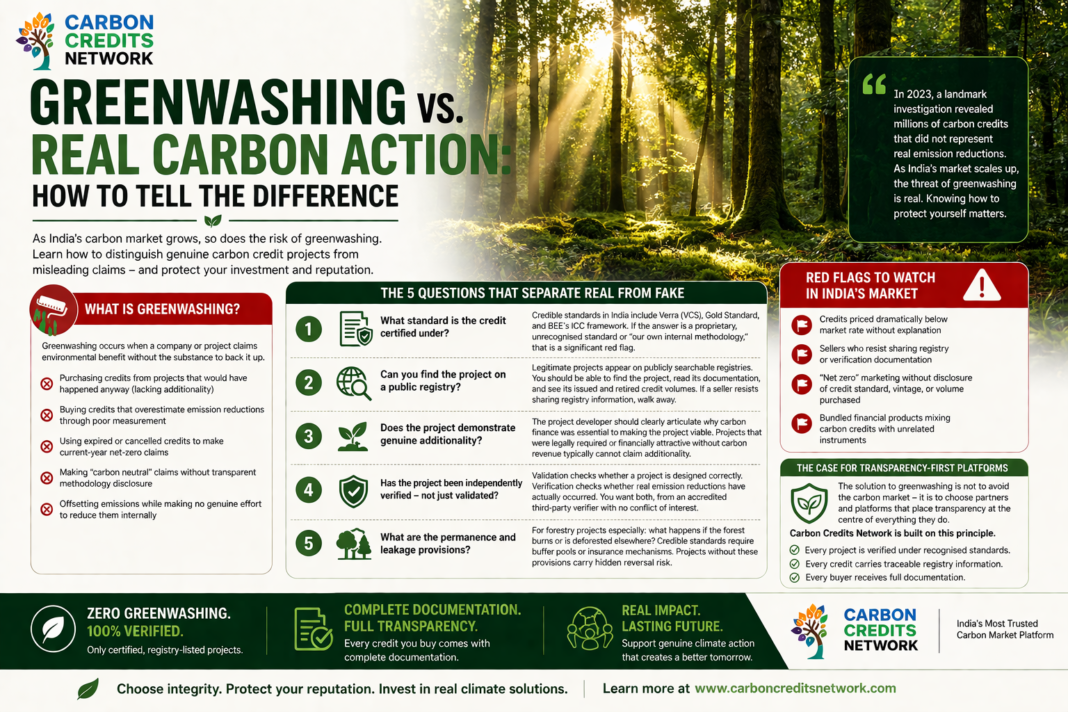
As India’s carbon market grows, so does the risk of greenwashing. Learn how to distinguish genuine carbon credit projects from misleading claims — and protect your investment and reputation.
Greenwashing Integrity Transparency Verification
In 2023, a landmark investigation revealed that a major certifier had issued millions of carbon credits that did not represent real emission reductions. The global fallout was significant — credit prices dropped, company reputations suffered, and regulators scrambled to tighten standards. As India’s carbon market scales up, the threat of greenwashing is not hypothetical. It is real, it is present, and knowing how to protect yourself matters.
What Is Greenwashing in Carbon Markets?
Greenwashing occurs when a company or project claims environmental benefit without the substance to back it up. In the carbon credit context, it takes several forms:
- Purchasing credits from projects that would have happened anyway (lacking additionality)
- Buying credits that overestimate emission reductions through poor measurement
- Using expired or cancelled credits to make current-year net-zero claims
- Making “carbon neutral” claims without transparent methodology disclosure
- Offsetting emissions while making no genuine effort to reduce them internally
The 5 Questions That Separate Real from Fake
1. What standard is the credit certified under?
Credible standards in India include Verra (VCS), Gold Standard, and BEE’s ICC framework. If the answer is a proprietary, unrecognised standard or “our own internal methodology,” that is a significant red flag.
2. Can you find the project on a public registry?
Legitimate projects appear on publicly searchable registries like Verra’s and Gold Standard’s. You should be able to find the project, read its documentation, and see its issued and retired credit volumes. If a seller resists sharing registry information, walk away.
3. Does the project demonstrate genuine additionality?
The project developer should clearly articulate why carbon finance was essential to making the project viable. Projects that were legally required or financially attractive without carbon revenue typically cannot claim additionality.
4. Has the project been independently verified — not just validated?
Validation checks whether a project is designed correctly. Verification checks whether real emission reductions have actually occurred. You want both, from an accredited third-party verifier with no conflict of interest.
5. What are the permanence and leakage provisions?
For forestry projects especially: what happens if the forest burns or is deforested elsewhere? Credible standards require buffer pools or insurance mechanisms. Projects without these provisions carry hidden reversal risk.
Red Flags to Watch in India’s Market:
• Credits priced dramatically below market rate without explanation
• Sellers who resist sharing registry or verification documentation
• “Net zero” marketing without disclosure of credit standard, vintage, or volume
• Bundled financial products mixing carbon credits with unrelated instruments
The Case for Transparency-First Platforms
The solution to greenwashing is not to avoid the carbon market — it is to choose partners and platforms that place transparency at the centre of everything they do. Carbon Credits Network is built on this principle. Every project featured on our platform is verified under recognised standards. Every credit carries traceable registry information. And every buyer receives full documentation of the emission reductions they are purchasing.
India’s carbon market can only achieve its climate and economic potential if trust is its foundation. That trust is built one verified credit at a time.
Zero Greenwashing. 100% Verified.
Carbon Credits Network features only certified, registry-listed projects. Every credit you buy through our platform comes with complete documentation and full transparency.