
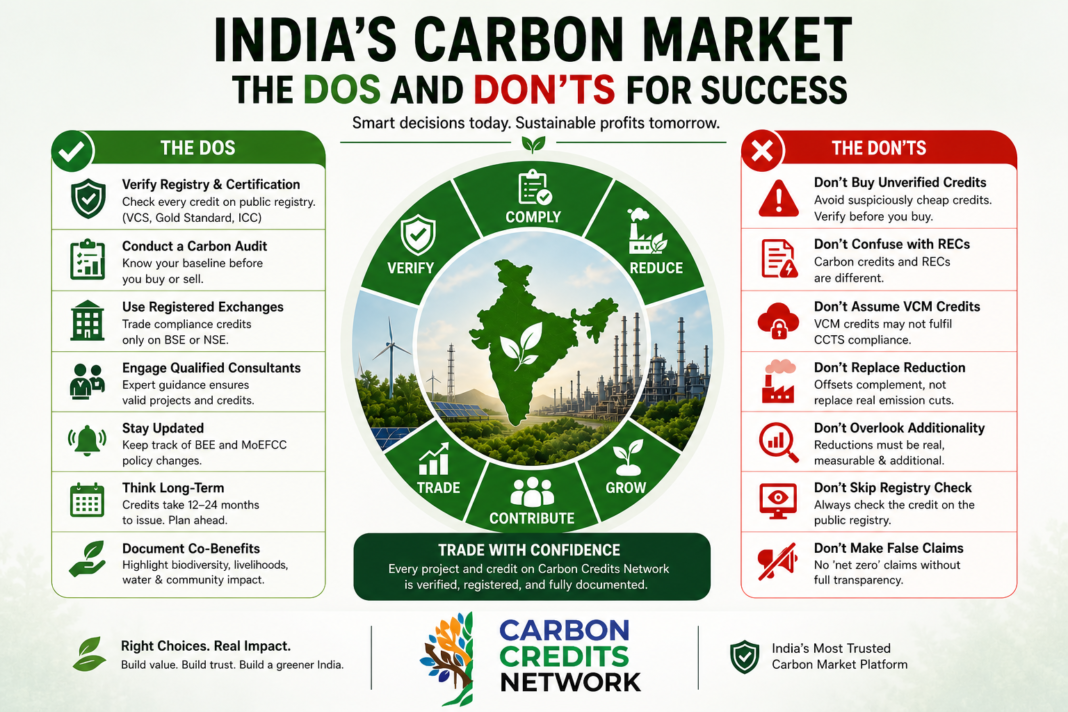
India’s carbon market is growing fast — and with opportunity comes the risk of costly missteps. Whether you are a first-time investor, a corporate sustainability manager, or a project developer, knowing what to do and what to avoid can be the difference between profitable participation and expensive failure.
✅ THE DOS
- Verify registry and certification of every credit (VCS, Gold Standard, ICC)
- Conduct a carbon audit before entering the compliance market
- Use registered exchanges (BSE/NSE) for compliance transactions
- Engage qualified consultants for project development
- Stay updated on BEE and MoEFCC policy changes
- Think in multi-year horizons — credits take 12–24 months to issue
- Document co-benefits (biodiversity, community livelihoods, water)
❌ THE DON’TS
- Don’t buy unverified or suspiciously cheap credits
- Don’t confuse carbon credits with RECs (they’re different instruments)
- Don’t assume VCM credits fulfil CCTS compliance obligations
- Don’t treat offsets as a substitute for actual emission reduction
- Don’t overlook additionality requirements
- Don’t purchase credits without checking the public registry listing
- Don’t make “net zero” claims without full, transparent disclosure
THE DOS
Do: Verify the Registry and Certification of Every Credit
Not all carbon credits are equal. In India, look for credits certified under Verra’s Verified Carbon Standard (VCS), Gold Standard, or issued under BEE’s Indian Carbon Credit (ICC) framework. Always check the credit’s serial number on the relevant public registry before purchasing. A legitimate credit has a traceable digital identity — if a seller cannot provide one, walk away.
Do: Conduct a Carbon Audit Before Entering the Compliance Market
Businesses covered under CCTS must know their current emission intensity benchmarks before they can understand whether they need to buy or sell credits. An accredited third-party auditor can help you establish your baseline and create a roadmap.
Do: Use Registered Exchanges for Compliance Transactions
Compliance carbon credits (ICCs) must be traded on authorised exchanges — currently BSE and NSE under CCTS rules. Peer-to-peer transactions outside these platforms are not valid for compliance purposes.
Do: Engage Qualified Consultants for Project Development
If you are developing an offset project, engage qualified carbon consultants and registered Project Design Document (PDD) writers. Errors in documentation are the most common reason for project rejection or credit invalidation.
Do: Think Long-Term
Carbon credits are not a quick-flip asset. Projects take 12-24 months to verify and issue credits. Build your strategy around multi-year horizons and plan accordingly.
THE DON’TS
Don’t: Buy Unverified or Suspiciously Cheap Credits
A carbon credit that costs significantly less than market price is almost always a red flag. Greenwashing scandals globally have been built on worthless, unverified credits. In India, such purchases can expose your business to regulatory and reputational risk.
Don’t: Confuse Carbon Credits with RECs
Renewable Energy Certificates (RECs) certify renewable energy generation; carbon credits certify emission reductions. They are two different instruments with different regulatory frameworks and are not interchangeable.
Don’t: Assume All Voluntary Credits Fulfil CCTS Compliance
Currently, compliance under CCTS requires Indian Carbon Credits (ICCs) issued through the BEE framework. Voluntary offset credits from international standards may not fulfil mandatory obligations — always confirm with your compliance consultant.
Don’t: Treat Offsets as a Substitute for Actual Emission Reduction
Regulators, investors, and customers globally are scrutinising companies that use offsets instead of genuinely reducing emissions. Offset credits should complement — not replace — a genuine decarbonisation strategy.
Don’t: Overlook the Importance of Additionality
A project must prove that emission reductions would not have happened without carbon finance. Projects that would have been built anyway typically cannot generate valid credits.
CALL TO ACTION: Trade with confidence on Carbon Credits Network. Every project and credit on our platform is verified, registered, and fully documented.Dive: Why Each Rule Matters