
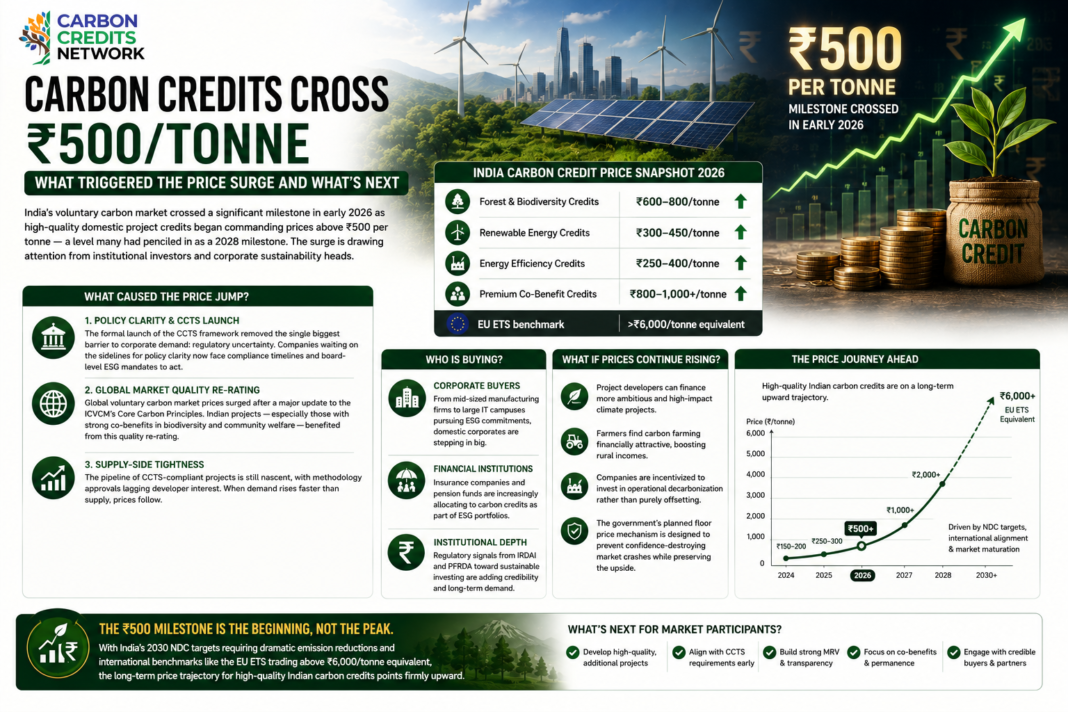
India’s voluntary carbon market crossed a significant milestone in early 2026 as high-quality domestic project credits began commanding prices above ₹500 per tonne — a level many had penciled in as a 2028 milestone. The surge is drawing attention from institutional investors and corporate sustainability heads.
What Caused the Price Jump?
Several converging factors drove the price movement. The formal launch of the CCTS framework removed the single biggest barrier to corporate demand: regulatory uncertainty. Companies waiting on the sidelines for policy clarity suddenly found themselves with compliance timelines and board-level ESG mandates to act.
Simultaneously, global voluntary carbon market prices surged following a major update to the Integrity Council for the Voluntary Carbon Market (ICVCM)’s Core Carbon Principles. Indian projects — particularly those with strong co-benefits in biodiversity and community welfare — were among the beneficiaries of this quality re-rating.
A third factor was supply-side tightness. The pipeline of CCTS-compliant projects is still nascent, with methodology approvals lagging developer interest. When demand rises faster than supply, prices follow.
📈 India Carbon Credit Price Snapshot 2026
Forest & Biodiversity Credits: ₹600–800/tonne ↑
Renewable Energy Credits: ₹300–450/tonne ↑
Energy Efficiency Credits: ₹250–400/tonne ↑
Premium Co-Benefit Credits: ₹800–1,000+/tonne ↑
EU ETS benchmark: >₹6,000/tonne equivalent
Who Is Buying?
The buyer composition is shifting. Domestic corporate buyers — from mid-sized manufacturing firms to large IT campuses pursuing ESG commitments — are entering the market in significant numbers. Insurance companies and pension funds, guided by IRDAI and PFRDA regulatory signals toward sustainable investing, are also beginning to treat carbon credit investments as a component of ESG portfolios, adding institutional depth to demand.
What If Prices Continue Rising?
Higher carbon prices have cascading effects: project developers can finance more ambitious projects, farmers find carbon farming financially attractive, and companies are incentivized to invest in operational decarbonization rather than purely offsetting. The government’s planned floor price mechanism is designed to prevent confidence-destroying market crashes while preserving the upside.
The ₹500 milestone is the beginning, not the peak. With India’s 2030 NDC targets requiring dramatic emission reductions and international benchmarks like the EU ETS trading above ₹6,000/tonne equivalent, the long-term price trajectory for high-quality Indian carbon credits points firmly upward.