
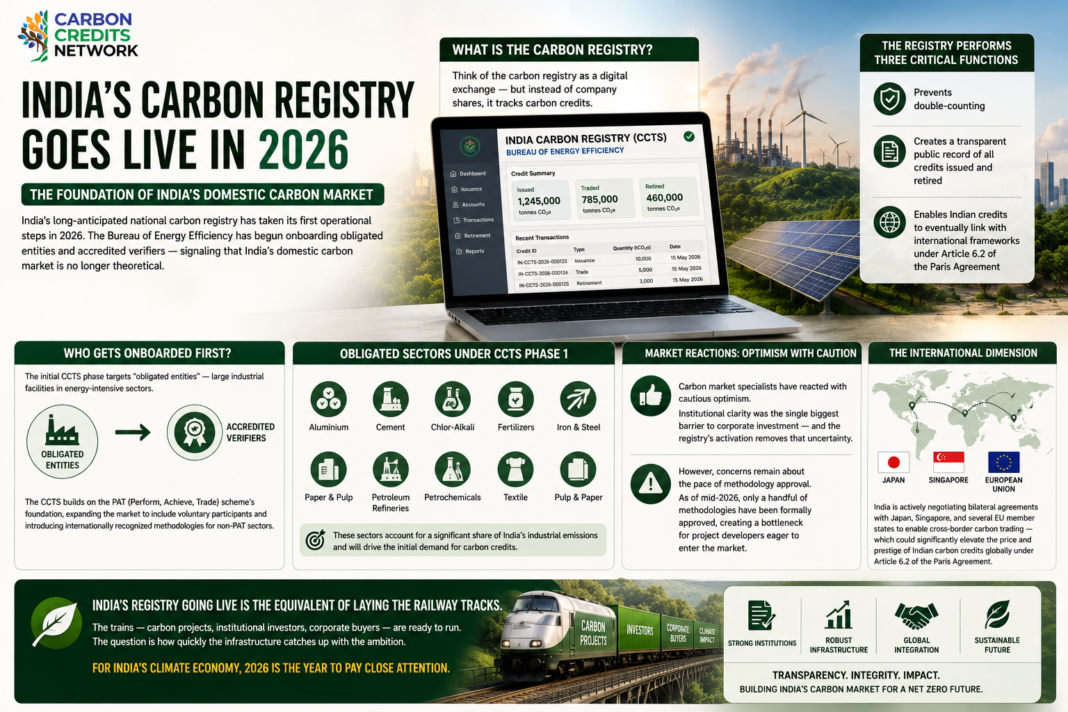
India’s long-anticipated national carbon registry has taken its first operational steps in 2026. The Bureau of Energy Efficiency has begun onboarding obligated entities and accredited verifiers — signaling that India’s domestic carbon market is no longer theoretical.
What Is the Carbon Registry?
Think of the carbon registry as a digital exchange — but instead of company shares, it tracks carbon credits. Every credit issued in India under the CCTS framework receives a unique serial number, is recorded on the registry, and can be bought, sold, or retired through the platform. The registry performs three critical functions: it prevents double-counting, creates a transparent public record of all credits issued and retired, and enables Indian credits to eventually link with international frameworks under Article 6.2 of the Paris Agreement.
Who Gets Onboarded First?
The initial CCTS phase targets “obligated entities” — large industrial facilities in energy-intensive sectors including aluminium, cement, chlor-alkali, fertilizers, iron and steel, paper and pulp, petroleum refineries, and petrochemicals. The CCTS builds on the PAT (Perform, Achieve, Trade) scheme’s foundation, expanding the market to include voluntary participants and introducing internationally recognized methodologies for non-PAT sectors.
🏭 Obligated Sectors Under CCTS Phase 1
Aluminium · Cement · Chlor-Alkali · Fertilizers · Iron & Steel · Paper & Pulp · Petroleum Refineries · Petrochemicals · Textile · Pulp & Paper
Market Reactions: Optimism With Caution
Carbon market specialists have reacted with cautious optimism. Institutional clarity was the single biggest barrier to corporate investment — and the registry’s activation removes that uncertainty. However, concerns remain about the pace of methodology approval. As of mid-2026, only a handful of methodologies have been formally approved, creating a bottleneck for project developers eager to enter the market.
The International Dimension
India is actively negotiating bilateral agreements with Japan, Singapore, and several EU member states to enable cross-border carbon trading — which could significantly elevate the price and prestige of Indian carbon credits globally under Article 6.2 of the Paris Agreement.
India’s registry going live is the equivalent of laying the railway tracks. The trains — carbon projects, institutional investors, corporate buyers — are ready to run. The question is how quickly the infrastructure catches up with the ambition. For India’s climate economy, 2026 is the year to pay close attention.