
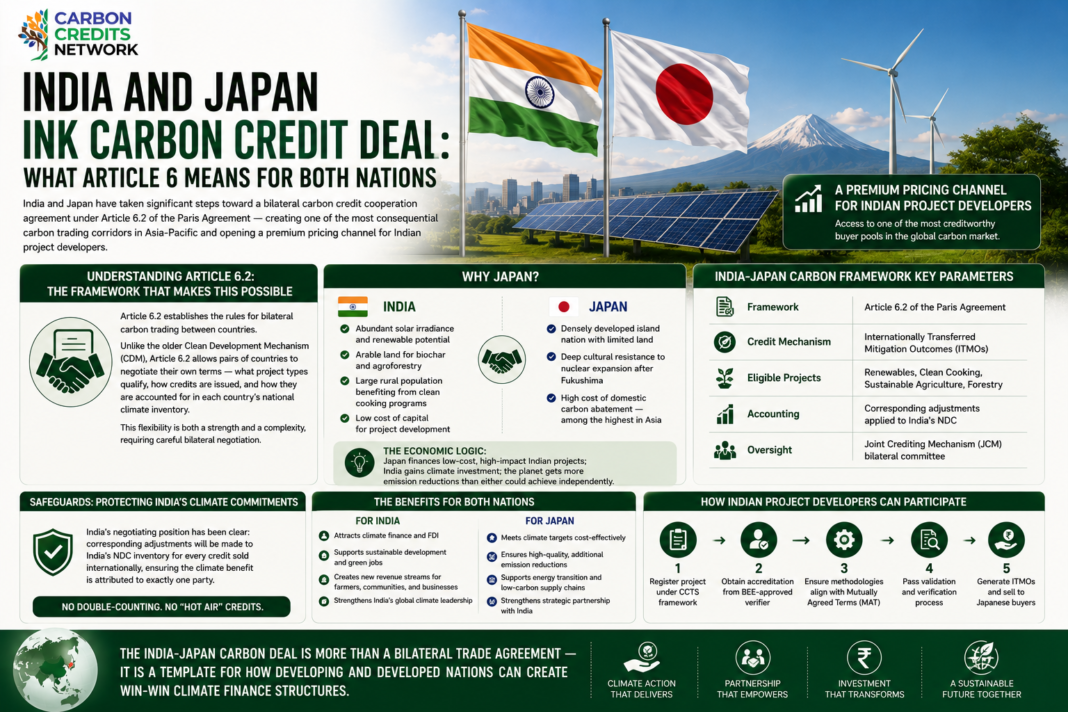
India and Japan have taken significant steps toward a bilateral carbon credit cooperation agreement under Article 6.2 of the Paris Agreement — creating one of the most consequential carbon trading corridors in Asia-Pacific and opening a premium pricing channel for Indian project developers.
Understanding Article 6.2: The Framework That Makes This Possible
Article 6.2 establishes the rules for bilateral carbon trading between countries. Unlike the older Clean Development Mechanism (CDM), Article 6.2 allows pairs of countries to negotiate their own terms — what project types qualify, how credits are issued, and how they are accounted for in each country’s national climate inventory. This flexibility is both a strength and a complexity, requiring careful bilateral negotiation.
Why Japan?
Japan’s climate strategy has a structural challenge: it is a densely developed island nation with limited land for large-scale renewable deployment and deep cultural resistance to nuclear expansion after Fukushima. Japan’s cost of domestic carbon abatement is among the highest in Asia. India, by contrast, has abundant solar irradiance, arable land suitable for biochar and agroforestry, and a massive rural population that can benefit from clean cooking programs. The economic logic is clear: Japan finances low-cost, high-impact Indian projects; India gains climate investment; the planet gets more emission reductions than either could achieve independently.
🤝 India-Japan Carbon Framework Key Parameters
Framework: Article 6.2 of the Paris Agreement
Credit Mechanism: Internationally Transferred Mitigation Outcomes (ITMOs)
Eligible Projects: Renewables, Clean Cooking, Sustainable Agriculture, Forestry
Accounting: Corresponding adjustments applied to India’s NDC
Oversight: Joint Crediting Mechanism (JCM) bilateral committee
How Indian Project Developers Can Participate
Japanese buyers have historically paid above-market rates for credits reported against Japan’s NDC, because the domestic cost of equivalent abatement in Japan is far higher. To participate, Indian developers will need to register projects under the CCTS framework, obtain accreditation from a BEE-approved verifier, and ensure methodologies align with the Mutually Agreed Terms (MAT) negotiated between the two countries.
Safeguards: Protecting India’s Climate Commitments
India’s negotiating position has been clear: corresponding adjustments will be made to India’s NDC inventory for every credit sold internationally, ensuring the climate benefit is attributed to exactly one party. No double-counting. No “hot air” credits.
The India-Japan carbon deal is more than a bilateral trade agreement — it is a template for how developing and developed nations can create win-win climate finance structures. For Indian project developers, it represents access to one of the most creditworthy buyer pools in the global carbon market.