
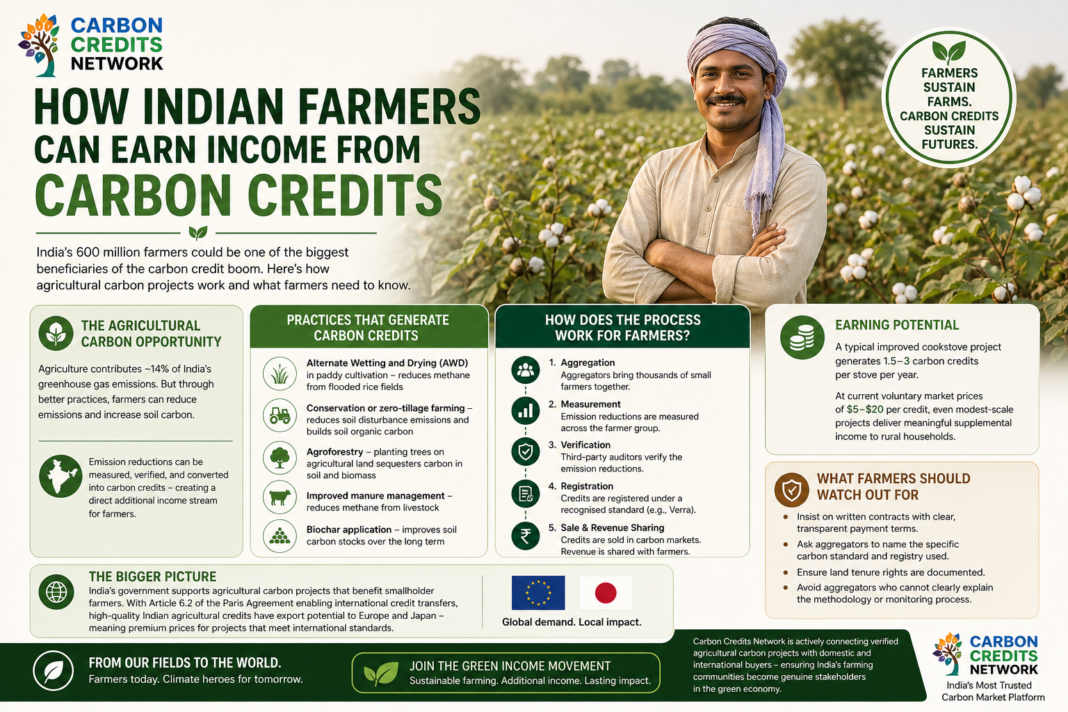
India’s 600 million farmers could be one of the biggest beneficiaries of the carbon credit boom. Here’s how agricultural carbon projects work and what farmers need to know.
Agriculture Farmers Rural India Income Sustainability
When people think of carbon credits, they often picture industrial smokestacks, stock exchanges, or multinational corporations. Rarely do they picture a farmer in Vidarbha changing the way she tills her soil — and earning money for it. But that is precisely what India’s carbon market is beginning to make possible.
The Agricultural Carbon Opportunity
Agriculture accounts for approximately 14% of India’s total greenhouse gas emissions — primarily from rice cultivation (methane), livestock (methane), and nitrogen-based fertilisers (nitrous oxide). But the sector also holds enormous potential for carbon sequestration and emission reduction.
When farmers adopt practices that reduce these emissions, the difference between old and new emission levels can be measured, verified, and converted into carbon credits — which can then be sold on voluntary or compliance markets, giving farmers a direct additional income stream.
What Practices Generate Carbon Credits?
- Alternate Wetting and Drying (AWD) in paddy cultivation — significantly reduces methane from flooded rice fields
- Conservation or zero-tillage farming — reduces soil disturbance emissions and increases soil organic carbon
- Agroforestry — planting trees on agricultural land sequesters carbon in soil and biomass
- Improved manure management — reduces methane from livestock
- Biochar application — improves soil carbon stocks over the long term
How Does the Process Work for Farmers?
Individual farmers rarely enter the carbon market alone. The transaction costs of measurement, verification, and registration are too high for a single smallholder. Instead, aggregators — companies or NGOs that pool thousands of small farmers — manage the process collectively.
The aggregator measures emission reductions across the farmer group, hires a third-party auditor to verify them, registers credits under a recognised standard (like Verra’s VM0042 methodology), then sells the credits. Revenue is shared with farmers through direct payment, input subsidies, or community benefit funds.
Earning Potential: A typical improved cookstove project can generate 1.5–3 carbon credits per stove per year. At current voluntary market prices of $5–$20 per credit, even modest-scale projects can deliver meaningful supplemental income to rural households.
What Should Farmers Watch Out For?
- Insist on written contracts with clear, transparent payment terms before adopting new practices
- Ask aggregators to name the specific carbon standard and registry being used
- Ensure land tenure rights are documented — international buyers require this for due diligence
- Avoid aggregators who cannot explain the methodology or monitoring process clearly
The Bigger Picture
India’s government has signalled strong support for agricultural carbon projects, particularly those benefiting smallholder farmers. With Article 6.2 of the Paris Agreement enabling international credit transfers, high-quality Indian agricultural credits have export potential to European and Japanese buyers — meaning premium prices for the projects that meet international standards.
Carbon Credits Network is actively working to connect verified agricultural carbon projects with both domestic and international buyers — ensuring that India’s farming communities become genuine stakeholders in the green economy, not just bystanders.
Connecting India’s Farmers to Global Carbon Markets
Carbon Credits Network provides verified project listings, aggregator connections, and market access for agricultural carbon initiatives across India.